


Posted in:
On: October 29, 2026
Motherhood Gets Easier When Children Are Not the Center
This post may contain affiliate links, which means I make a small commission (at no extra cost to you) on any purchases you make through clicking a link on this site. See my full disclosure here.
I’ve come to realize that motherhood genuinely gets easier when my children are not the center of the family. That statement will probably sound harsh to some people, because we have been taught that good mothers build their entire lives around their children.
But believe it or not, there was a generation of mothers raising large families, running entire households, preserving food, educating their children, and tending to their homes from the ground up. Somehow, they were not drowning in the constant pressure to keep their children entertained every waking moment. They were not Googling “toddler activities near me” at nine o’clock on a Tuesday morning, wondering how they were going to fill the next eight hours. They had real work to do, and their children were brought into that work.

Somewhere along the way, we did not simply change how we raised children. We changed how we thought about children in the first place. The key is to shift how you think about your child.
If you see your child as someone whose needs must continually be met through a steady flow of stimulation, entertainment, reassurance, and emotional management, and whose final outcome rests entirely upon you, then of course your days will feel exhausting and never-ending. You are carrying responsibilities that shouldn’t belong to you, responsibilities your child should gradually learn to carry, and responsibilities that belong to God alone.
No wonder so many mothers are burnt out. We’re doing too much. The problem is not always that we have too many children, too much housework, or too little help. It’s that we have assumed responsibility for things God never expected from us. We have begun to treat children like customers to satisfy and outcomes to produce. Once you think about your child that way, motherhood becomes dreadfully heavy and, frankly, impossible.
Here’s the kicker. This way of mothering doesn’t actually make children more secure. It teaches them complete dependency and it teaches the mother to look to her own effort as the thing that will save and secure her child, rather than faithfully pointing that child to Christ and trusting God with the result.
There is an easier and far more faithful way to mother, and it begins with shifting the way you think about your child. Your children belong to God before they belong to you. They are people made in His image, entrusted to your care and placed within a family where they can learn to obey, contribute, work, worship, serve, and grow. They are not the center of the family. They are part of the family. That distinction changes everything.
Your responsibility is to faithfully train the child God has placed in front of you. You teach. You discipline. You model repentance. You give affection. You establish expectations. You bring them into the work and worship of the family. You point them to Christ. Then you trust God with the things that only God can do.
At the same time, you stop carrying the things your children are capable of learning to carry themselves. When you stop doing your child’s part and stop trying to do God’s part, you finally have the strength to do your own part well. You have more energy for training, discipleship, correction, affection, consistency, and the patient work of building a strong Christian family culture. For the first time in a long time, you can relax a little. You can breathe and begin taking some of the weight off your shoulders.
I want to show you what this looks like in our home, where I believe modern parenting has gone wrong, and why expecting more from your children can make life better for the entire family. Because motherhood becomes much lighter when children stop being the center and begin taking their rightful place as capable, contributing members of the family. Moms, we are doing too much. Much of what we are doing is preventing our children from becoming capable while exhausting us in the process.
You Are a Steward, Not the Savior
This is the foundation for everything else: your children cannot take their proper place within the family until you first remember whose children they are. God is at the center, you are the steward, and your children are being trained to live faithfully within the family He placed them in.
One of the heaviest ways to mother is to believe that the person your child becomes is entirely the result of your parenting. You are responsible for raising your child faithfully. You are not responsible for the final result.
You are certainly influential. You have been given real authority and real responsibility. Scripture gives parents commands concerning how we teach, discipline, and bring up our children. But influence is not control.
Your child has a nature of his own. He lives before God. He will make choices you did not make for him, struggle with weaknesses you may not understand, and encounter circumstances you could never have planned.
Psalm 127 says children are a heritage from the Lord. They are entrusted to us. Our job is to train our children in righteousness by modeling faithfulness and repentance, discipleship, discipline, prayer, and teaching them the word.
Scripture tells us that faithful training eventually produces rest. Proverbs 29:17 says, “Discipline your son, and he will give you rest; he will give delight to your heart.” A well-trained child gives his mother rest because she is no longer carrying every responsibility for him that he should have been taught to carry himself. That is our part.
Paul writes in 1 Corinthians, “I planted, Apollos watered, but God gave the growth.” You plant. You water. God gives the growth. An enormous amount of a mother’s anxiety comes from trying to perform all three jobs. You are a steward, not the savior, and that’s really hopeful, because once you lay that down you become much calmer about the daily work He has actually given you.
Some of what I talk about today comes from the book Hunt, Gather, Parent. What struck me was how many of the concepts in that book were simply a rediscovery of what Scripture has been instructing all along. Ironically, I don’t think the author is a Christian. Because what she observed in other cultures, children contributing, participating, being trained into the rhythms of daily life, is not actually new and profound advice. It’s biblical.
Yet today, we’ve created a completely different paradigm, where the child becomes the center of the home, and everything about our days bends around them: the schedule, the activities, the energy, everything. When you believe every need must be met by you, every outcome depends upon you, and every part of family life must be arranged around the children, even the ordinary daily work of motherhood begins to feel insurmountable. That daily work becomes lighter when you stop building a separate universe around your children.
This is where the promise in Proverbs begins to make practical sense: a well-trained child gives his mother rest. That training begins by bringing children into the life and work of the family rather than placing them at the center of it.

Children Belong in the Life of the Family
Our culture has divided the day into two competing categories: what the mother needs to accomplish, and what the children need the mother to provide for them.
Mother needs to make dinner, clean, work on a project, but the children need an activity while she does said tasks. Mother wants to visit with someone, but the children might find it boring, therefore they need to have a separate activity or mother just foregoes visiting altogether. Mom wants to garden, read, exercise, host, or work, but first she must solve the persistent problem of what to do with the children.
I think we have the question backward. Rather than waking up wondering how you will keep your children occupied while you live your life, begin looking for ways to bring them into the life you are already living.
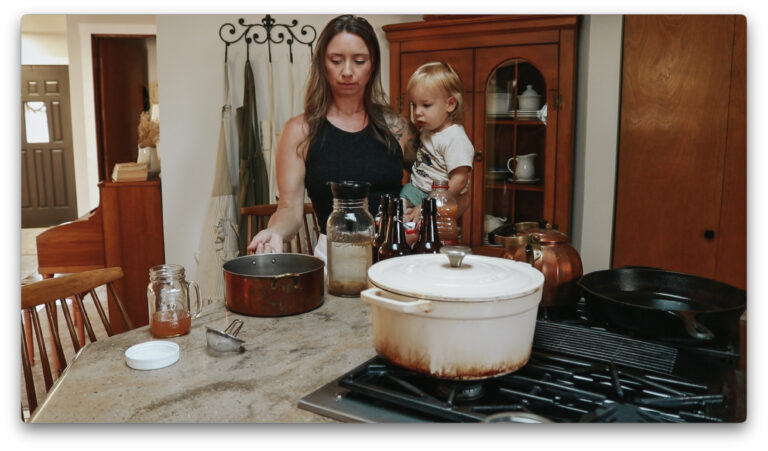
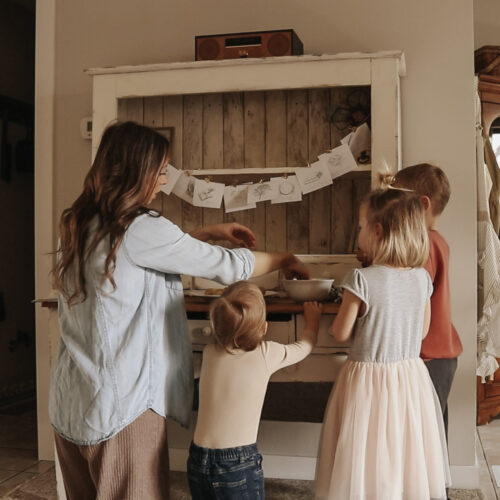
Bring them into the kitchen. Let them work beside you in the garden. Give them a cloth while you clean. Teach them to greet adults, wait through a conversation, even ask questions to people who are older than them. Teach them to clear the table, pack the bag, feed the animals, and participate in maintaining the home they are a part of.
This is an invitation to stop treating ordinary family responsibility as an interruption to childhood. Children do not need to be separate from the daily work of a household. They need to be welcomed into it.
When you live this way, you are no longer managing two separate worlds: your real life and the children’s life. There is one family life, and everyone has a meaningful contribution to it. Everyone has different responsibilities based on age and ability, but everyone belongs within it.
A child who eats the family’s meals can gradually learn how food reaches the table in the first place. A child who wears clothing can learn that clean laundry does not descend upon the household like manna. A child who enjoys the home can help care for the home as part of the duty bestowed upon them simply by being part of the family.
That lightens the mother’s load over time, but contribution gives the child something just as important. It gives him meaning, empowerment, and fulfillment. Your child does not only want to receive from the family. He wants to contribute to the family.
You Cannot Build a Peaceful Home From Panic
But here’s the problem. It is very difficult to raise peaceful, capable children in a home that is constantly being led by a mother stuck in fight-or-flight.
If you’re reading all of this and this is exactly what you want for your home too but you’re totally burnt out as a mother and cannot even possibly imagine how you can cultivate this kind of Christian home, I want you to know that I was there too. I was so burnt out, so overstimulated, and constantly on edge that this all felt impossible. There was absolutely no way I was able to do any of this even though I desperately wanted this for my children.
But listen, I give myself grace for this season of my life because I was living with something called nervous system dysfunction, and I have a theory that so many mothers are struggling with this. Basically, it’s living in a chronic state of stress which puts your body in fight or flight mode every second of the day. If you’re struggling with this, you know exactly what I mean. None of what I’m talking about would have been possible when I was living in chronic stress.
For me, the Lord showed me that I could not build a peaceful home from a body that was constantly stuck in panic. If you relate to that, I have a free workshop linked below where I share the exact process that helped me heal from nervous system dysfunction. You can join that using the link below.
Children Want to Be Useful
Children want to be needed. We’ve mistaken their restlessness for a need for more stimulation, when really it’s a need for more significance. They’re not bored. They’re purposeless. There’s a difference.
One of the fastest ways to make motherhood harder is to think of children as incapable. Of course we don’t say it directly, but we communicate it through our habits. A child tries to fold a towel, and we redo it. They try to pour something, and we take the pitcher because they might spill. They try to sweep, but the crumbs are moving into strange new territories, so we shoo them away.
The message our children get from this is: real work belongs to adults. Your contribution creates more trouble. Your job is just to play.
But to the child, chores are play. If we stifle that, then when the child is ten years old and they show no initiative and we wonder why and think it’s just a character flaw. But for years, we taught him that helping was optional and generally unhelpful.
Young children want to participate and they crave being helpful. It’s innate for a toddler to be helpful, and isn’t that just the Lord’s mercy? As the mother, we can train that desire into real competence, but it happens over time and with a lot of intentionality, and a certain amount of being willing to let the task be slower, messier, and done imperfectly while they learn.
Speed isn’t the goal. Making them feel empowered that they could do the task is the goal. What would take me ten minutes might take them thirty, but those thirty minutes turn such a profit when they’ve learned the skill, are doing meaningful work that contributes to the home, and are growing into people who understand that homes are maintained by the people who live in them. By the way, it’s 30 minutes that the children are occupied and I can do something else!
I get tons of questions about chore lists by age. But it doesn’t really work like that because capability will look different for every child. Age, development, and temperament all come into play. Also, the specific tasks in your home matter too. The general rule of thumb is to always be thinking, how can I bring my child into this task?
If you’re making dinner, your one-year-old might carry a potato from the pantry, your two-year-old might wash them, your four-year-old might help measure ingredients, your five-year-old might stir or cut something, and your eight-year-old might prepare one entire part of the meal. If you’re folding laundry, the youngest find all the socks and put them in a pile, while an older toddler can match the socks, while an even older child can fold, hang, and put away the clothes. The specific job changes with the child, but the question stays the same: what part of this can I teach them to do?
Children are often far more capable than we assume, but they cannot become capable while we continue choosing efficiency over development.
Your Need for Efficiency Can Keep a Child Dependent
This is where our desire for capable children collides with our desire to get everything done quickly. I get it. It’s so much easier to just do it yourself. But doing everything yourself is faster today and far more costly five years from now.
A mother who always chooses the fastest route can completely handicap her child. She ties every shoe instead of letting her child struggle because it’s faster to get out the door that way. She clears every plate because she is afraid one might break. She packs every bag because allowing the child to forget something feels more inconvenient than continuing to remember everything for him. Then she becomes increasingly resentful that the household cannot function without her. But that dependence developed inside a system where one person continually stepped in and took over.
Motherhood is not only about completing today’s task with the least friction. Proverbs 31:27 says that she “looks well to the ways of her household.” Looking well to your household does not mean personally performing every task within it. It means building a household that functions well, and part of that work is training the people in it to become capable.
Every time you resist the urge to take over, your child gains competence. Motherhood becomes easier when kids are no longer the center, when you stop arranging the entire household around what is fastest and easiest for them and begin letting them do what they are perfectly capable of doing.
Of course, handing a child a complicated task and walking away is not training. Children need to be taught. Show them the job. Do it together. Break the task down into smaller portions and give them one part to own. Check their work. Correct what needs correcting. Then step back as they become competent through practice. Once they have mastered that part, give them another until they can eventually handle the entire job.
Then you begin to experience the rest Scripture promises. Proverbs 29:17 says, “Discipline your son, and he will give you rest; he will give delight to your heart.” The rest does not come from centering the child and doing everything for him. It comes through the patient work of training him.

It’s Not Your Job to Protect Them From Struggle
As a mother, it’s uncomfortable watching our children be uncomfortable. We tend to do more. At the same time, we are also desperate for them to learn new things and become more capable, so we bring this anxious, over-eager energy to the task. We praise every tiny move because we are trying to keep them motivated, convince them that they are capable, and make sure they never feel discouraged while they are learning.
The entire time he is working, we stand nearby offering a steady stream of “Good job!” “You’re so smart!” “You’re the best helper!” as though the child might lose the will to continue the task if thirty seconds pass without applause.
Praise has a place, but it should tell the truth. When every ordinary action receives a celebration, praise eventually becomes meaningless. More importantly, the child can begin doing the work for the reaction rather than for the satisfaction of learning, contributing, or doing the job well. Colossians 3:23 gives us a much better aim: “Whatever you do, work heartily, as for the Lord and not for men.” We want to train our children to find satisfaction in doing good work before the Lord, not to need a steady stream of human approval in order to continue.
Instead of asking himself, “Did I work hard? Did I improve? Am I proud of what I made?” he begins looking at your face and asking, “Did Mom like it?” Now his motivation lives outside of him.
When the praise is attached to his identity, “You’re so smart,” “You’re so talented,” “You’re such a good kid,” failure becomes far more threatening in their mind. If being smart is the thing that earns approval, he may begin avoiding anything that could make him look less smart.
This can become especially unhealthy between siblings because children are always noticing who gets praised for something that the other child does without recognition. So begins sibling rivalry. I see this in my home all the time because I am that mom who is constantly praising. I give a child praise and another will say, what about me mama? Even my two-year-old, “me toooo?”
The bottom line, moms, is that we are doing too much. You do not have to narrate every success or turn each child into a collection of flattering labels. Instead, you can simply enjoy what they did without evaluating it at all. Or ask them to: “Tell me about what you made.” “How did you think to do that?” “How does it feel now that you finished?” That keeps the child’s attention on the work itself rather than continually pulling it back toward your approval.
The same is true when they struggle. Confidence is not something we install in children by repeatedly telling them they are confident, capable, brilliant, or exceptional. Confidence comes from perseverance. Romans 5 tells us that suffering produces endurance, endurance produces character, and character produces hope. Our children develop confidence in much the same way: by moving through difficulty and discovering that they can endure it.
The child tries something difficult, feels frustrated, continues anyway, and eventually discovers that he can do more than he thought. He spills the water and learns how to clean it up. He forgets something and experiences the inconvenience of having forgotten it. He struggles with the zipper long enough to finally understand how it works. Those experiences form confidence because the child now has proof that difficulty has purpose. But if we continually rescue him the moment he struggles, he never learns that lesson.
Of course there are times to help. A child may genuinely lack the skill, strength, or maturity a situation requires. Let him feel a reasonable amount of frustration without treating the frustration as an emergency. A child who is always rescued from discomfort does not become more secure. He becomes more convinced that discomfort is dangerous and that he cannot handle it alone.
In my house I have a little motto I tell my children when they’re struggling through a task I know they can do: “You were made to do hard things.” It’s something I tell myself often too. Bottom line. We are doing too much.
You Can Take the Weight Off Your Shoulders
If there’s anything I hope you take from this, I hope it’s that you can relax a little bit. You can breathe a breath of fresh air and take the weight off your shoulders. Motherhood gets easier when you do less for your child and stop putting them at the center. You do not need to complete every task for your child. You do not need to guarantee the person he eventually becomes. Your responsibility is faithful stewardship.
Teach your children. Discipline them. Bring them into the work and worship of the family. Give them real opportunities to contribute. Allow them to struggle long enough to develop strength.
If you are reading this thinking, “I want to mother this way, but I am so overstimulated and reactive that I cannot tolerate the mess, noise, resistance, and repetition that training requires,” that is exactly the gap I help mothers bridge in my free workshop. I walk you through the biblical brain-rewiring process I used to calm chronic fight-or-flight, renew my mind, and begin responding like the peaceful, present, self-controlled mother I wanted to be. That workshop is completely free, and the link is below.

Kyrie Luke





Leave a Reply