

Posted in:
On: November 23, 2026
Why Motherhood Feels Overwhelming Even When You Serve All Day
This post may contain affiliate links, which means I make a small commission (at no extra cost to you) on any purchases you make through clicking a link on this site. See my full disclosure here.
At the height of my overwhelm, I was serving my family all day and was completely burnt out, overstimulated, and constantly on edge, and I believed motherhood felt impossible obviously because everyone needed too much from me and I was sacrificially serving all day long. Then God showed me something I did not want to admit: I looked selfless, but my “selflessness” was actually just self-focus.
That revelation became one of the ways God freed me from constant overwhelm in motherhood. I am going to show you what he revealed to me through the book of Philippians, why you can spend your entire day serving your family while your thoughts still revolve around yourself, and how I began turning my mind toward Christ and the people in front of me without denying my exhaustion or neglecting real needs. By the end, you will understand the hidden reason that can make motherhood feel relentlessly overwhelming and what you can begin practicing today to cultivate more peace, joy, and self-control in your home.

I Only Remembered What Everybody Required From Me
In Philippians 1:3, Paul says:
“I thank my God in all my remembrance of you.”
Paul is imprisoned, and yet the opening direction of his mind is gratitude for other people. That immediately confronted something in me, because in my overwhelmed mind, it was easy to remember only what people required from me.
I remembered the noise my children were making that was overstimulating me. I remembered the questions they were asking that were irritating me. I remembered the messes they were making that were robbing me of my time. I remembered the unfinished work, the interruptions and everything I still had to do for everybody.
I was technically thinking about my family all day, but I was not always thinking about the people themselves. I was thinking about what they required from me. There is a difference.
I began deliberately remembering the people. I would picture each of my children’s faces individually and think about something distinct that I loved about each one of them. I would think about how each one was made in the image of God, how God lined up my life’s circumstances to bring these particular children to me, and what he was already doing in their lives. I would think about my husband and thank God for the ways he sacrifices for our family, provides for us, serves the Lord, and leads our home.
It was amazing what turning my mind toward others, especially the people in my family, could do. It helped lift me out of the fog and the chaos of everyday life.
My children are more than the noises they are making that are overstimulating me, the questions they are asking that are irritating me, or the messes they are making that are robbing me of my time. They are so much more than that. They are souls who need to be discipled.
My husband is more than a hurtful comment he made, an area where we do not align, or a decision where we disagree. He is my spouse. He is my partner in life. He is there with me to disciple our children. We are doing that together, and I get to be his helper.
My family, all the people in my family, are made in the image of God and entrusted to my care for this portion of their lives. What a blessing that is.
Now, when the house is loud and chaotic and very stimulating, I practice thanking God that I am not walking through an empty life. Thank you, Lord, for all the voices in my home. Thank you for this home that is busy and not as clean as I would like it. Thank you for the people who need me, rely on me, love me, challenge me, and give my life so much purpose.
The circumstances have not necessarily changed. But the direction of my mind has.
If you’re reading all of this and this is exactly what you want for your home too, but you are totally burnt out as a mother and cannot even imagine how you could cultivate this kind of Christian home, I want you to know that I was there too. I was so burnt out, so overstimulated, and constantly on edge that all of this felt impossible. There was absolutely no way I could do any of it, even though I desperately wanted it for my children.
But listen, I give myself grace for that season of my life because I was living with something called nervous system dysfunction, and I have a theory that so many mothers are struggling with this. Basically, it is living in a chronic state of stress that keeps your body in fight-or-flight mode throughout the day. If you are struggling with this, you know exactly what I mean. None of what I am talking about would have been possible for me while I was living in chronic stress.
If you relate to that, I have a free workshop linked below where I share the exact process that helped me heal from nervous system dysfunction and begin becoming the peaceful, present mother I wanted to be. You can join that workshop using the link below.
I Stopped Asking Only What the Moment Was Doing to Me
Later in Philippians 1, Paul says:
“What has happened to me has really served to advance the gospel.”
Paul could look at objectively miserable circumstances and see what God was producing through them. This realization gave me a new question for motherhood.
My mind naturally wanted to just marinate in misery and ask questions like:
Why is this happening to me? Why does today have to be so hard? Why can’t my children leave me alone for a minute? Why can’t I have one minute of peace and quiet? Why can’t anything be easy for once?
But Paul’s response taught me to ask:
Okay, Lord, what can this moment produce?
Can this conflict produce wisdom? Can this interruption that is so annoying produce more patience? Can this mess become an opportunity to teach and disciple my children? Can my child’s sadness become an opportunity for closeness, ministering to him, and teaching him what God’s Word says? Can my exhaustion remind me to depend on the Lord? Can a difficult season where I feel absolutely wrecked form something in me that comfort never could?
The answer is yes to all of it.
In hindsight, it is easy to see what God was producing. But my goal is to train my mind to think about that in the moment, not only in hindsight, but in the moment when I am living it.
That question moves me out of passive suffering. I am looking for what God can produce through it. My prayer becomes: Teach me how to rejoice in all my circumstances, Lord. Make me more Christ-like in all circumstances, Lord.
I Believed My Family Was Keeping Me From Relief
In Philippians one, towards the end, Philippians one, twenty-two, it says, If I am to live in the flesh, that means fruitful labor for me. Yet which I shall choose I cannot tell.
Fruitful labor.
He’s serving. He is using his body as an act of worship through fruitful labor. In verse twenty three he says, I am hard pressed between the two. My desire is to depart and be with Christ, for that is far better. Yes.
Yes, that is the desire. That is the goal. That is so much better. I mean, that would be easier to depart and be with Christ. But the Lord had more work for him. He says, but to remain in the flesh is more necessary on your account. I just think, yes, the Lord has more work for me to do here. That’s why I’m here. That’s why I’m enduring what sometimes feels extremely hard and yet is nowhere near as hard as what Paul had to go through.
But it is more necessary. My difficult days are not identical to Paul’s suffering, but the principle still confronts me: the Lord can use my life in service to others even when comfort would feel easier. On the account of others, on the account of my family, on the account of those that I serve, it is more necessary for me to be here.
In twenty-five he says, Convinced of this, I know that I will remain and continue with you all for your progress and joy in the faith.
He is turning his attention outward to others, even though it’s costing him so much. It’s costing him his own comfort. He is so far from comfort. ‘But for your progress and joy in the faith’, he turns his attention outward to others.
For their progress and joy in the faith. In twenty six he says, so that in me you may have ample cause to glory in Christ Jesus because of my coming to you again.
His life wasn’t organized only around what would bring him the quickest relief. He recognizes that his presence benefits other people, and so does mine. That’s why the Lord has me here, regardless of my circumstances.
There are days where I think, I just want everybody to stop needing me. I want to disappear. I just want this day to be over. Those thoughts, they come from genuine exhaustion and sometimes just genuine needs. You know, I genuinely need more food or sleep or quiet or, you know, even medical care sometimes, or just really practical help.
Obviously that’s all important, but even after those needs are addressed, sometimes there can be lingering overwhelm and exhaustion and fears.
I just think about Paul and I think, you know what, my presence matters here. My children, my family benefit from having a mother who is here serving them with fruitful labor. My husband benefits from having a wife who is there for him, welcomes him, is his soft landing, honors him, respects him. My whole home benefits when I bring prayer and warmth and playfulness and love into it.
The people in my home, my family, they’re not keeping me from a meaningful life. Loving them and pointing them to Christ is part of the meaningful life God has given me. My presence can contribute to the progress and joy of my family today.
Philippians two four says, Look not only to his own interests, but also to the interests of others.
I love the grace in this. I love how Paul says not only, look not only to his own interests, because he’s not saying that his needs never matter. The Lord cared about his needs too. But Paul does direct us away from a life that revolves exclusively around our own interests.
I realized that overwhelm, overstimulation, anxiety, and exhaustion could make my mind intensely self-focused.
How am I feeling? How much longer can I tolerate this? How much longer am I going to have to tolerate this? Why is this so hard for me? When will I get a break? What if I cannot make it through the rest of the day?
The more I thought like this, the bigger every sensation and frustration began to feel. It became a self-perpetuating cycle.
I felt uncomfortable. Then I monitored the discomfort, marinated in the misery, and the more closely I monitored it, the more threatening and all-consuming it felt. Then I became anxious about how overwhelmed I was becoming, which gave me another sensation to monitor.
Meanwhile, I believed I was entirely others-focused because I was physically doing things for other people. But inwardly, I was thinking about myself all day.
That is why the answer was not simply doing fewer things for my family. I needed to practice turning my mind outward.
What This Looks Like in a Real Moment
I just think of difficult moments in my home that are just so very minor in comparison in the grand scheme of things, and definitely in comparison to what Paul was going through. I think of those moments of just very acute chaos, like everybody’s screaming and fighting, and multiple people are interrupting me and trying to talk to me and needing things from me all at the same time. The baby is screaming, crying, and I have 47 things that I need to do, and I also have in the back of my mind 27 things that I forgot to do. My body is just annihilated. I’m so tired, and I just feel my anxiety rising and I just feel like I just wanna snap. I just wanna yell.
I have all these lies popping into my head and all these justifications of why I deserve to lash out at my family. Instead I just interrupt that pathway.
I look at the scene from a bird’s eye view. I look at my family from a bird’s eye view.
I ask:
What does everybody need in this situation? How can I faithfully serve in this situation?
Maybe one child needs guidance or correction. Maybe another child needs reassurance or comfort. Maybe I need to chug some water and go to the bathroom.
I take a minute to pray and ask the Lord for wisdom. I remind myself:
The Lord showers me with his grace and wisdom.
Then I breathe. I slow down. I slow everything down. I literally move in slow motion. Instead of screaming over everybody, I say:
“Okay, I can hear all of you. I know you all need something from me, but I’m going to help one person at a time.”
I pick up the baby. I give him some love. I address the next child.
Others-focused love does not require me to neglect myself. I can take care of my needs too. I am simply no longer treating my own discomfort as the only important need in the room.
I Began Picturing Christ in My Actual Kitchen
Paul continues in Philippians 2:
“Have this mind among yourselves, which is yours in Christ Jesus.”
This whole work of renewing my mind and rewiring my brain is amazing because I don’t have to invent a new personality. I am learning to think in a way that belongs to Christ. I am learning to be more Christlike. I am learning to think and see things the way Christ does.
Jesus willingly took the form of a servant. He moved toward people in their weakness and faults. He was compassionate, and he was obedient.
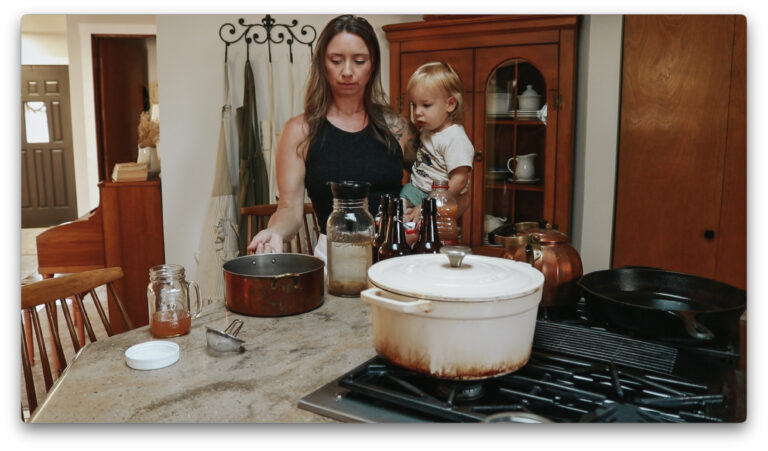
I began picturing Christ in my home. I mean in my actual home, standing in my kitchen during those chaotic and stressful parts of the day.
How would he respond?
He is not frantic. He is fully attentive. He is not confused about which needs require attention first. He has wisdom from above. He sees my children as souls, eternal souls. He sees my exhaustion with compassion. He knows when service is required and when serving is the most faithful and obedient thing to do. He knows when rest is the most faithful and obedient thing to do. He is not serving from fear, a desire to control, bitterness, or a need to prove himself. He is serving from love and obedience.
Then I picture myself following him through the scene. My movements slow down like his. My face softens and becomes more joyful. My voice becomes softer, sweeter, gentler, more loving, and more welcoming. I become genuinely interested in the people in my home and the people standing in front of me. I listen long enough to understand them and understand their hearts.
I remind myself:
The mind of Christ is available to me, even here. I can have the mind of Christ in this moment.
Even My Desire to Improve Was Keeping Me Focused on Myself
In Philippians 3, Paul describes all the reasons he once had confidence in his own performance. Then he lets them go because knowing Christ is worth so much more.
Motherhood can become another avenue for placing confidence in the flesh.
Did I do this enough? Did I do that enough? Am I making the right choice? Did I feed everybody correctly and healthfully? Did I respond in exactly the right way? Am I doing as much as other mothers?
Again, my mind is turned inward through constant self-evaluation. I realized that even my desire to improve could become self-obsession when I spent too much time measuring myself and my performance. But once again, I was the center of my attention.
Paul, instead, directs my attention toward Christ. My greatest treasure is not the image of being a perfect mother. My greatest treasure is knowing Christ.
When I fail, Philippians gives me permission to stop staring endlessly at the failure. Paul talks about forgetting what lies behind and straining forward to what lies ahead.
God Taught Me What to Do With Anxious Thoughts
Philippians 4 has become such a lifeline for me.
Paul tells us not to be anxious about anything, and then he tells us what to do with anxious thoughts. Bring everything to God through prayer, specific requests, and thanksgiving.
I pray specifically. Lord, I am anxious about my energy level. I am anxious about how I am going to make it through the day. I am anxious about what the next three months will look like. I am anxious about my children, our finances, or our health. Give me wisdom for this child. Please provide practical help. Show me what can be removed from my schedule. Help me speak honorably and respectfully to my husband and to other people, even when they fall short. Give me strength for today’s responsibilities.
Then I turn toward thanksgiving. Thank you for my children. Thank you that I have a direct line to you and can ask for wisdom. What a privilege. Thank you that I do not have to live three months from now. I can live today. Thank you for the ways you have provided for us. Thank you for the people you have brought into our lives to help, support, and encourage us. Thank you that your peace will guard my heart and mind in Christ Jesus.
God will give me what I need for the life he has called me to live today.
Then Philippians 4:8 tells me exactly what to think about:
Whatever is true, honorable, just, pure, lovely, commendable, excellent, and worthy of praise, think about these things.
That is the playbook for my thoughts.
God is present. God is faithful. God is patient. God is generous toward me. My children are made in his image. My home is full of life. The difficult moment in front of me can produce fruit.
Those things are true and worthy of praise.
Contentment Had to Be Learned
Paul says:
“I have learned in whatever situation I am to be content.”
Contentment is learned. I love that.
Just because contentment does not come naturally to me when I am overwhelmed, exhausted, anxious, overstimulated, or uncomfortable does not mean I am failing. It means contentment must be practiced.
It can be practiced when I feel overstimulated. It can be practiced when I am stressed. It can be practiced when I am exhausted beyond belief. It can be practiced when the house is messy, I feel uncomfortable, and I want to control everything around me.
Contentment can be practiced and learned.
One of the ways I learned it was by no longer allowing my feelings to become the center of the home. My feelings give me information. They can show me that I need rest, food, help, prayer, repentance, a changed schedule. They do not get to determine how I speak to my family. They do not get to tell me that because I feel overwhelmed, everybody else has become a burden.
The Real Freedom
I thought freedom from overwhelm would come when everybody finally stopped needing so much from me. I thought I needed fewer interruptions, messes, less noise, more cooperation, more rest.
Some practical changes absolutely help. But God gives a much deeper freedom.
He showed me that even though I appeared to be doing everything for everybody else, my own feelings had become the center of my attention. My thoughts were revolving endlessly around myself, my comfort or lack thereof, my performance, my desires, and what everybody else was doing to me.
The way out was turning my eyes toward Christ. It was remembering the people themselves instead of remembering only what they required from me. It was asking what a difficult moment could produce. It was becoming genuinely interested in the desires and affairs of my husband and children. It was learning when love required service and when obedience required rest. It was receiving the Lord’s care and allowing that care to overflow toward everybody around me.
Motherhood still contains loud days, difficult children, physical exhaustion, interruptions, disagreements, messes, and unfinished work. But those things no longer have to consume my entire field of vision. Joy, peace, service, and contentment can grow in genuinely difficult circumstances.
If you are reading this thinking, “I can see how self-focused my thoughts have become, but I still feel too burnt out and stuck in fight-or-flight to respond differently,” that is exactly the gap I help mothers bridge in my free workshop.
I walk you through the biblical brain-rewiring process I used to calm chronic fight-or-flight, renew my mind, and begin responding like the peaceful, present, self-controlled mother I wanted to be.
That workshop is completely free, and the link is below.

Kyrie Luke








Leave a Reply