

Posted in:
On: January 20, 2026
How Journaling Can Heal Your Brain and Help You Become a Peaceful Mother
This post may contain affiliate links, which means I make a small commission (at no extra cost to you) on any purchases you make through clicking a link on this site. See my full disclosure here.
It would be a tragedy if you believed that the overwhelm you feel in your chest during the morning chaos, the feeling of being touched-out by 9am, the short fuse you have with your husband and children, the dread you feel for nighttime wakings, and the way sibling squabbles make your skin crawl would be your permanent reality. But they don’t have to be.
And today I’m going to show you how something as simple as a pen and a notebook can begin to change all of this—not by “venting it out,” but by actually healing your brain while you journal. You’re going to see how this method is completely different from traditional journaling, how to use it not only after the hard moments but right in the middle of them, and how that shift alone can help you to become the peaceful mother you always imagined you’d be.

Why Traditional Journaling Often Falls Short
If you’re anything like me, you’ve probably tried journaling before because you’ve heard the benefits. You bought the pretty notebook, you poured your heart out on the page… and then you closed it and felt exactly the same—or honestly, maybe a little bit worse. And then this little journaling practice you committed to drifted away.
It’s not that you’re “bad at journaling.” And it’s not that journaling “just isn’t for you.” I used to say both of those things myself. The real issue is that no one ever taught you how to use journaling as a tool for actual sanctification—a tool that retrains the patterns in your mind so they reflect truth instead of reacting from old habits, old wounds, and old emotions.
I had completely written journaling off. But after years spent wrestling with what Scripture says about renewing the mind and what neuroscience reveals about rewiring the brain, the missing piece finally became clear. I started testing how those very principles could be woven into the simple act of journaling. And what emerged was a method that didn’t just “feel good in the moment,” but actually changed how I showed up in my home.
That process became the Becoming Journaling Method—and that’s what I’m sharing with you today.
How the Becoming Journaling Method Is Different

If the version of you that is impatient, snappy, and overwhelmed is clearer in your mind than the version who stays calm… guess which one is going to show up more?
If you replay your worst reactions more vividly than your best intentions, you’ll keep repeating them. And the way most moms journal only reinforces that cycle.
Traditional journaling often strengthens the very neural pathways you’re trying to escape.
Here’s what usually happens:
You sit down at the end of a long day and “brain dump” everything that went wrong—the yelling, the mess, the guilt, the marriage tension, the anxiety about tomorrow. It feels cathartic at the moment.
But neurologically, your brain is responding by sending stress chemicals racing through your body.
When you vent on paper, your brain doesn’t say, “Phew, glad we got that out. I feel so much better now.”
It says, “Wow, this must be really important. Let’s remember this.”
So the next time the kids are loud, or the house is a mess, or your husband forgets something, your brain already has a well-worn path: feeling overwhelmed, then yelling or snapping, then feeling guilty, then feeling completely defeated like you will never be able to break that cycle. Why? Because it’s a pattern you’ve practiced too many times before but haven’t been taught how to break.
This is why you can journal for five years and still feel like the same reactive, exhausted version of yourself.
Your brain does not change through venting. It doesn’t change through justification. Your brain changes through intentional retraining of those unhealthy neural pathways that have been created over time. Journaling can be a helpful tool to reroute those patterns toward healthy responses so that you can confidently thrive in complex emotional situations and know without a doubt that you’re going to show up as the most peaceful version of yourself in that moment.
So you can either journal to rehearse the woman you’re trying to escape—or rehearse the woman you’re becoming. But becoming her requires one critical shift.
Becoming Words vs. Resistance Words
I used to believe my overwhelm and exhaustion—and all the destructive reactions that came with them—would finally disappear once my circumstances settled down.
When I wasn’t chronically sick.
When the baby finally slept.
When my husband helped more.
When the kids weren’t so needy.
My life became a loop: when things were calm, I showed up as the woman I wanted to be. I’d get these little pockets of victory—sometimes a week, sometimes a day, sometimes just an hour. But the moment circumstances shifted, so did I.
I kept thinking, once things stay stable long enough, I’ll stop being so overwhelmed. Once everything calms down, I won’t react like this anymore.
But here’s the thing: your brain won’t rewire when your difficult circumstances change for a long enough period of time to give you a break from the chaos. It will change when you learn how to rewire your brain within those circumstances.
When I finally learned how to do this—change myself within those circumstances—the overwhelm, exhaustion, and chronic illness did actually disappear. I had it backwards all along.
So when you walk around saying, even silently:
“I’m so overwhelmed.”
“I’m so exhausted.”
“I am so angry.”
Your brain treats these like instructions—directing your thoughts, emotions, and body back into the old destructive patterns it already knows.
But when, instead, you begin to say things like:
“I am steadfast.”
“I am nurturing.”
“I am held and protected by the Lord regardless of my circumstances.”
Your nervous system immediately starts to soften, and your brain gets the message: okay, this is who we are. How would this person respond in this situation?
That’s the core of the Becoming Journaling Method. We don’t just scribble about our circumstances, what went wrong, and why it was horrible. We rehearse the identity God is forming in us inside of our hard circumstances.
This means that when life throws us struggles—and it will—we get to choose the version of ourselves we want to show up as. Our reactions, tone, presence, and responses are shaped because we are working with how the Lord designed our brains to function.
We are priming our brains for the responses we want them to have in the very struggles we so often face.
Creating Your Personal Becoming Vocabulary

Step one of the Becoming Journaling Method is to make a list of Becoming words and Resistance words.
Becoming words are words that make you feel excited, hopeful, alive, encouraged. Resistance words aren’t necessarily bad words inherently—just words that, for whatever reason, your brain resists. Resistance words activate shame, not transformation. They remind you of who you aren’t instead of calling you toward who you’re becoming.
I used to try to tell myself I could be patient and kind, but unknowingly I was just making myself mad. Those words were reminders of how far off from that I actually was.
This is why when you try to journal “I am calm,” you might feel the opposite. It might actually just make you more upset.
Your brain does not care if a word is good. Your brain cares whether that word feels good to you.
If “calm” reminds you of all the times you weren’t calm…
If “patient” reminds you of all the times you snapped…
If “kind” reminds you of a standard you’re not currently meeting…
Your brain will resist it.
So once you’ve created your list of resistance words, set them aside. Eventually these words will have positive associations, but for now, identify them and move on.
Instead, create an image of the person you want to become using your Becoming words—words that make you feel hopeful and excited.
Take the word “calm,” for example. Maybe that word irritates you. Maybe your body tenses because you’ve been told to “calm down” too many times. Instead of forcing that word, shift your focus to the picture of calm.
What does a calm mother actually look like to you?
Maybe she’s peaceful.
Maybe she’s nurturing.
Maybe she’s steady, gentle, or tender.
Those words might finally speak to the woman you know you could be—without triggering the shame of who you’ve been.
That is your Becoming word.
Journaling in the Middle of the Hard Moments
So many women only journal during quiet time, and they’re leaving so much growth on the table. The moments when you’re the most triggered are actually the times when your brain is the most moldable.
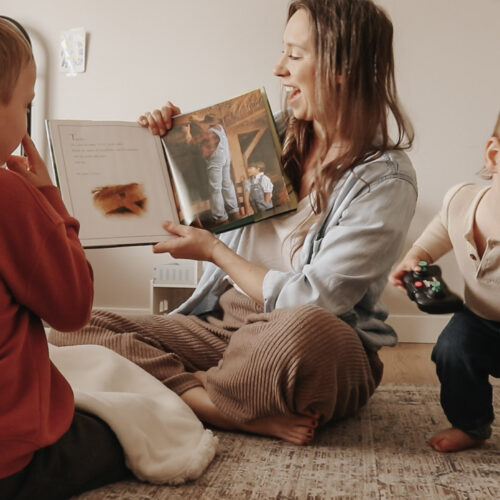
Journal with your kids in the room. While they play. While you’re feeding the baby. Even while your husband is nearby.
Most people journal after the hard moments—after bedtime went badly, after they yelled, after they snapped. You will begin to journal through them, and that’s where transformation happens.
To rewire your brain in these situations, you have to stop and do a Becoming page in your journal. It’s okay to let the baby cry for a minute while you do this. Resistance will show up—it’s normal—but once you add a layer between discomfort and reaction, everything changes.
That added layer is simple:
You feel the discomfort.
Your brain insists you should react.
Instead, you pick up your journal, write your Becoming page, and show up as the woman you know you can be.
This is how you become the woman who doesn’t snap when she’s frustrated. The woman whose presence settles a room. The woman whose children feel safe and whose home feels peaceful because she is peaceful.
Pre-Rehearsing the Woman You Want to Be

There comes a point in motherhood where you realize your kids can keep doing the exact thing that “drives you crazy,” and you can still show up completely differently. Not because they’ve changed—but because you have.
A Becoming Page is where you pre-rehearse who you want to be before the moment ever arrives, so when it does, you already know how you’re going to show up.
You’ll answer four simple questions:
Who do I want to be today?
How do I want to feel as I move through my home?
What do I want to happen?
What do I want to notice?
You’re not planning logistics. You’re rehearsing a posture that glorifies the Lord and a peaceful presence that might feel out of reach right now. You’re giving your brain a clear picture of who you intend to be so that when real life hits, you’re already practiced in showing up with peace, steadiness, and dignity.
Becoming the Peaceful Mother You Long to Be
Your brain really can begin to heal when you journal, and you really can become the peaceful mother you long to be—but not when you use your notebook as a dumping ground for everything that’s wrong in your life.
When you learn to use it as a training ground for the woman God is forming you into, everything changes.
You don’t have to stay the mom who dreads the day, feels ruled by her emotions, or trapped in old destructive patterns. You can become the mom whose presence shifts the atmosphere in her home.
And right now, there’s an opportunity to learn exactly how to do this step by step.
You can access the Becoming Journaling Method as a free bonus when you enroll in my course. Enrollment is officially open, and I would love to welcome you into our thriving student community.
If you’ve been waiting for the right moment to invest in real, lasting transformation—not another surface-level fix—this is it. This is your invitation to stop reacting, start retraining your brain, and become the woman God is forming you to be right in the middle of real life.
When you journal with intention, you’re not just writing—you’re becoming.

Kyrie Luke





Leave a Reply