


Posted in:
On: February 20, 2026
The Cost of Modern Motherhood — and the Peace God Offers Instead
This post may contain affiliate links, which means I make a small commission (at no extra cost to you) on any purchases you make through clicking a link on this site. See my full disclosure here.
Modern motherhood has become so over engineered, and Christian moms are paying the price with their peace. I see posts all the time where moms everywhere are talking about how leaving and going to work is so much easier than staying home with the children. Or toxic mommy culture which says that the only way to get through motherhood is to have a constant flow of coffee all day then decompress with wine at night.
Mothers who think that career success is more fulfilling than motherhood — something is wrong here. We aren’t parenting the right way if we think that this is true. This is not discipleship, because we are told explicitly in the Word that there is NO GREATER JOY than to hear that my children are walking in the truth” (3 John 1:4).
But the reality is that I get emails from mothers similar to this one frequently:
“Very often I simply have no zest for life anymore and just drag myself through the day. I suffer from fibromyalgia, among other things. I have pain all over my body every day. I’m constantly irritable and have hardly any patience with the children. To distract myself, I constantly check my phone to look something up, scroll, or do whatever.”
Discipling our children IS our joy and our purpose as Christian mothers. So where did this all go wrong?

I think part of the problem is that we’ve been groomed to think that traditional motherhood and homemaking are ways of the past and not relevant in our lives anymore; but I think a lot of this comes from not having the skills of Christian parenthood passed down to us. We literally don’t even know how to disciple our children, what that even looks like, and what we ought to be doing everyday.
I am in no way an expert parent and don’t even feel qualified to talk about this since my children are still young – but I also think that kind of makes me the perfect person to talk about this because I’m in the thick of it, learning as I go, committed to doing it the best I can and to make generational change in my family. I talk a lot about the burnout I experienced as a mother, and I was burnt out because I had been discipled into a version of motherhood that stripped me of authority, confidence, and clarity.
I’m going to show you the biblical approach that actually simplifies life with young kids—not a routine, not a system, but a return to how God designed motherhood to function.
Gentle parenting tells us to never say no. Permissive parenting says kids will eventually figure it out. Authoritarian parenting makes us feel like drill sergeants in our own homes. And we’re left more confused and exhausted than ever as mothers today.
But we have to remember that we serve a God that is unchanging and who actually did give us direction on parenting — and this biblical approach simplifies motherhood. It makes our priorities crystal clear. Doesn’t mean it’s easy, but it takes the confusion out of the equation. It takes the insecurity and doubt away — which is what I believe adds so much to our stress — that backburner question mark: am I doing this right?
I’m sharing three biblical principles that have completely changed how I parent my young kids. These aren’t just nice ideas — they’re practical, actionable strategies that you can start using today. A clear framework rooted in Scripture that transforms both your children AND your daily experience as a mother. And the best part is that they actually work with God’s design for children instead of against it.
Train Your Children Joyfully

A child who isn’t taught to obey early will eventually demand control later. This might make some people uncomfortable, but it’s absolutely foundational: We need to teach our children obedience.
Now, I know what you might be thinking. Obedience training — are we raising children or puppies? I’ve heard that exact argument, and honestly, it breaks my heart because it reveals how far we’ve drifted from biblical wisdom — so much so that we are actually training puppies more than our children.
“Children, obey your parents in the Lord, for this is right.” (Ephesians 6:1, ESV)
“Children, obey your parents in everything, for this pleases the Lord.” (Colossians 3:20, ESV)
“Train up a child in the way he should go; even when he is old he will not depart from it.” (Proverbs 22:6, ESV)
“Whoever spares the rod hates his son, but he who loves him is diligent to discipline him.” (Proverbs 13:24, ESV)
“Hear, my son, your father’s instruction, and forsake not your mother’s teaching, for they are a graceful garland for your head and pendants for your neck.” (Proverbs 1:8–9)
“Discipline your son, and he will give you rest; he will give delight to your heart.” (Proverbs 29:17)
“For the moment all discipline seems painful rather than pleasant, but later it yields the peaceful fruit of righteousness to those who have been trained by it.” (Hebrews 12:11)
Here’s the truth: Teaching obedience is a blessing to them.
It’s about equipping them for a life that flourishes under God’s good and perfect design. Teaching them how to navigate a fallen world full of sinful people as a sinful person themself.
Think about it from a Christian worldview. God doesn’t give us commands to restrict our joy — He gives them to protect us and multiply our joy. When we obey God, we experience freedom, peace, and abundant life. When we stray away, we tend to experience confusion, chaos, broken relationships, and consequences that steal our peace. The same principle applies to our children. When they learn to obey, they’re learning to trust authority, to delay gratification, to think beyond their immediate desires.
But here’s what’s often the missing piece that takes training our children from simply obeying commands to raising children who obey from the heart because they trust the authority guiding them:
First, we actually need to proactively train our children before correction is required.
Next, when we do need to correct our children, we need to do it joyfully. This isn’t about creating little robots who comply out of fear. It’s about creating a home culture where obedience is connected to love, trust, and God’s goodness. The goal is a child whose heart trusts authority because authority has been trustworthy. Obedience starts feeling light when children understand it as a blessing.
So how do we actually do this? Let me give you three practical tips that have transformed our home.
1. Gamify Training
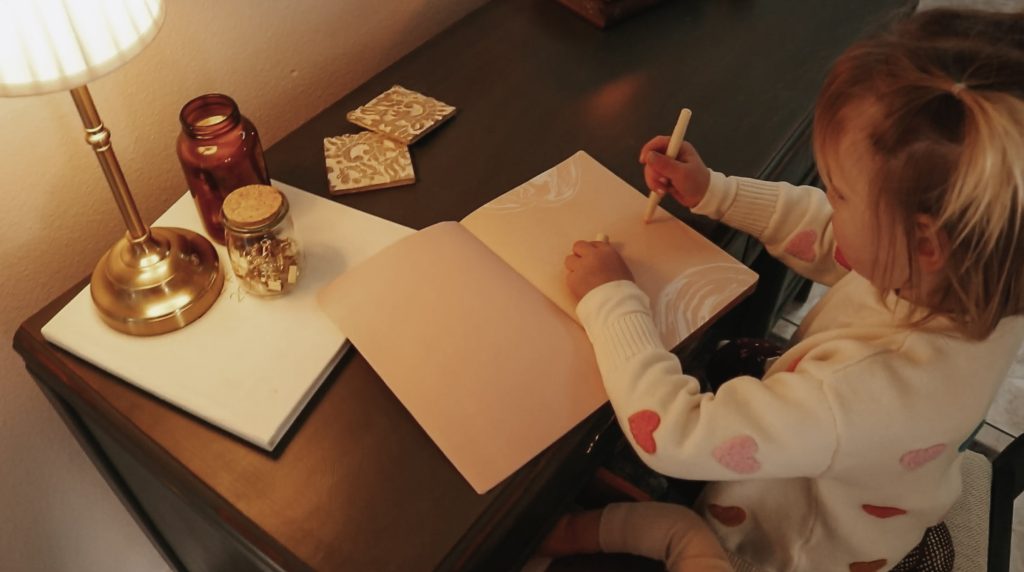
This is where child training can actually become fun.
Kids are wired to play, so why not use that to your advantage and gamify your training? Teach them that it’s fun to obey mommy.
“Can you obey Mommy the FIRST time I ask? Let’s practice! I’m going to ask you to do something, and you’re going to say yes mama and do it right away with a happy heart. Ready? Go put your shoes in the closet. GO!” And when they do it, you celebrate like they just won the Olympics. “You DID it! You obeyed the first time! High five!”
For chores: “I wonder if you can pick up all the blocks before this song ends? Let’s see! Ready, Set, Go!” Make little games out of whatever it is that you’re learning to do. The more you proactively parent before the situation actually arises, then when it’s actually game time and you need them to obey, say in public, or when it comes to their own safety, they’ve already practiced that obedience muscle and they’ll know exactly what to do.
But, of course, there will always be times that call for correction and thats where the next practical tip comes in:
2. For Instances Demanding Correction
The Wise Words for Moms Chart by Ginger Hubbard.
It’s a tool that helps you address both the behavior AND the heart issue behind it. Here’s how it works:
When your child disobeys — let’s say they hit their sibling — you don’t just correct the behavior by disciplining. You need to disciple them. And this takes time. You walk them through a process. First, you address what they did wrong. “You hit your brother. That was disobedient and unkind.” Then, you show them what God says about that issue. “The Bible says in Ephesians 4:32, ‘Be kind to one another…’
But you don’t stop there. This is the part most of us miss. You teach them what they SHOULD do instead. “Next time you’re frustrated with your brother, you can use your words to tell him how you feel, or you can come get Mommy to help you work it out.”
Then, you tell them how they can make it right – and this is your opportunity to teach true repentance. Do you see the difference? You’re not just saying “don’t do that.” You’re giving them a biblical framework for understanding WHY it’s wrong and WHAT to do instead.
You’re not just disciplining — you’re discipling.
The chart helps you have these conversations consistently because it gives you the structure. And over time, your children start to internalize this pattern. They start to think biblically about their choices.
3. Teach Through Storytelling
I hear it all the time, moms are so frustrated because they feel like they are constantly correcting their child on the same things. And sometimes this is a true discipline issue, and maybe poor consistency with that discipline. But sometimes, it’s actually because the children genuinely aren’t registering whatever the cue is.
As humans, we tend to remember things a lot more when we hear a story first. So it sounds too simple, but it’s incredibly effective, especially with toddlers. If you don’t want your toddler to do something, tell them a story about it first.
For example, let’s say your toddler keeps leaving their shoes right in the middle of the doorway and tripping everyone who walks by. Instead of correcting them every single time in the moment, you sit down earlier in the day and tell a story: “There once was a little girl who loved taking her shoes off as soon as she came inside. But instead of putting them away, she left them right by the door every single time.
One afternoon, her mommy was carrying a big, heavy basket of laundry — towels stacked high, arms full. She didn’t see the shoes. She tripped. The basket flew. Towels scattered everywhere. Mommy fell hard on her knee and started to cry.
The little girl felt scared. She didn’t want her mommy to be hurt. And that’s when she learned something important: when we take care of our things and put them where they belong, we’re loving our family. Shoes don’t stay by the door — they go in their special home — so our house can be peaceful and everyone can be safe.”
I’m telling you, they will never do it again. There’s something about storytelling that helps young children understand cause and effect in a way that simple commands don’t. It engages their imagination and helps them visualize the consequences. And it sticks with them way longer than a simple command.
You’re still requiring obedience. But you’re making it engaging. You’re working with their developmental stage instead of against it. And you’re getting on their level. That’s such a good picture of the grace the Lord has for us too.
And here’s what I’ve found: when obedience is connected to joy, relationship, and God’s Word, children actually WANT to obey. It’s not a burden, it actually makes them feel secure. It’s part of the rhythm of a loving Christian home.
Many mothers struggle to train obedience joyfully — but the key isn’t more rules or stricter discipline. It’s learning to turn ordinary moments into living, breathing lessons of the Christian faith – and what it means to be a disciple of Jesus.
Turn Everyday Moments into Opportunities to Point Them to Christ

You don’t need a formal devotional time every day—though those are wonderful. You don’t need to have all the answers or be a theologian. You just need to be attentive to the moments God gives you throughout the day to draw your children’s hearts toward Him.
“And these words that I command you today shall be on your heart. You shall teach them diligently to your children, and shall talk of them when you sit in your house, and when you walk by the way, and when you lie down, and when you rise.”
(Deuteronomy 6:6–7, ESV)
Let me give you some examples of what this might look like in real life. These are silly simple, but they make a huge impact on your children.
Example 1: Night Frights
Your three-year-old wakes up at 2 AM crying because they had a bad dream. You’re exhausted. You just want to comfort them quickly and get back to sleep as quickly as possible. But then you remember that God uses ordinary moments like this to build connection, point their hearts to Him, and teach them where true safety comes from.
So instead, you use this little night terror as an opportunity to explain to your child that even though we can’t see God — he always sees us.
You hold them close and you say, “I know you’re scared. Bad dreams can feel so real. But you know what? Even though we can’t see God, He can always see us. He never sleeps. He’s watching over you right now. The Bible says in Psalm 121, ‘He who keeps you will not slumber.’ God is awake, and He’s taking care of you right now.” Then pray with them.
You’re not dismissing their fear. You’re not saying “just pray about it” in a way that feels trite. You’re meeting them in their fear and pointing them to the character of God. You’re teaching them that God is present, protective, personal and cares about them — even their bad dreams. And over time, they start to instinctually reach for God in their fear.
You’re building their faith in these everyday moments.
Example 2: When You Mess Up
This one is huge, and it’s something I have to practice regularly because I mess up a lot.
Let’s say you lose your patience. You snap at your four-year-old because they spilled food for the third time today, and your tone is harsh. You see their little face fall, and you know you were wrong — you feel guilt for crushing their spirit.
This is an opportunity to point them to Christ and model repentance. To show them that you are grieved over your own sin but you don’t have to live with the guilt because while we were yet sinners — Christ died for us.
So, you get down on their level, and you say,
“Listen, honey mommy was wrong to yell — I spoke harshly with you and that’s not ok. My tone was unkind, and that was a sin. Will you forgive me?”
You can even do the wise words for moms chart on yourself to show them what you should have done instead and what the Lord says about having self-control even with your tone of voice.
And then—you take it one step further and say,
“You know what’s amazing? Even when Mommy sins, Jesus forgives me when I ask Him. That’s what we do in our family too. We say we’re sorry when we mess up, and we forgive each other, just like Jesus forgives us.”
You’re modeling repentance. You’re showing them that everyone sins—even Mommy—and that freedom is for everyone.
This might be one of the most powerful ways we point our children to Christ. They need to see that we need Jesus too. They need to see what it looks like to live in light of the gospel in the ordinary, messy moments of life. You don’t have to manufacture spiritual moments. God is already at work in your home. Your job is simply to have eyes to see it and a heart ready to point your children to Him.
When they see a beautiful sunset: “Look at what God made! Isn’t He so creative?”
When they’re struggling with a hard task: “You know what? God gives us strength to do hard things. Let’s ask Him to help you.”
When they’re sad because a friend was mean: “I’m sorry that hurt your feelings. You know, Jesus understands what it’s like to be hurt by people He loved. He’s close to you right now.”
Every moment is an opportunity. Every conversation is a chance to weave the truth of God’s character and the reality of the gospel into the fabric of your child’s understanding of the world.
This is discipleship. It just requires a mom who loves Jesus, loves her children, and wants her children to know Him too — to know the feeling of deep joy that comes from watching your children walk in truth, the kind of joy Scripture tells us is greater than any earthly success or accomplishment (3 John 1:4).
Creating Lasting Change
So, I watched this video that’s been going around, maybe you’ve seen it too, but it’s of this child who went to take a banana off this little rack thing hanging in the kitchen and the whole rack and the 157 things inside the rack all came tumbling down. Glass was shattered everywhere, it was a complete disaster. And the text on the video was something like, how to not traumatize your children or something to that effect. And the mom handled it beautifully. She was scared for a minute, you could tell she had that split second of wanting to freak out, and then she composed herself and said, its ok its ok. It was an accident, and she started cleaning it up.
I felt mixed emotions when I saw that. One, I felt so proud of that mother for handling it so well. And two, I felt sadness for all the times I didn’t handle situations like that so well. All the times I actually did freak out about a spill or something broken – where I was put into a state of fight or flight and couldn’t get myself out. And I thought about all of you in my audience who experience this daily – this living in low grade fight or flight constantly, that any little trigger sends you over the edge.
I thought about you reading that caption and feeling so much shame and I was grieved – for me, for you. And I realized something in that moment — so many of us aren’t lacking love, or faith, or desire to do better. We’re lacking the internal capacity to respond calmly when the intensely stressful moments hit. You might be here because you’re tired of reacting in ways that don’t match the woman you know you are in Christ — snapping, spiraling, shutting down — and you’re exhausted from the gap between who you want to be and how you actually show up when the pressure hits.
Maybe you feel stuck in the same patterns of overwhelm, mom anger, guilt, and discouragement, even though you’re praying, trying, and genuinely longing to renew your mind in a biblical way that actually works in real life.
Maybe you’ve caught glimpses of her — the calm, rooted, joyful, confident woman you’re becoming — but you don’t know how to hold onto her consistently when your nervous system is fried and the day falls apart.
If any of that feels uncomfortably familiar, you’re not alone. For so many moms, this overwhelm isn’t about effort or discipline — it’s because their body has been living in a constant state of panic. Stuck in fight-or-flight. Already maxed out before the day even begins. That was me. And real change didn’t come from a few breathing exercises or positive affirmations — it came from learning a full system that helped calm my nervous system, retrain my mind, and change how I actually responded in real life.
That’s why I created my free workshop, From Survival Mode to Peace-Filled Homemaking in 7 Days. Inside this workshop, I walk you through the exact process I use to calm my nervous system, break out of fight-or-flight, and begin responding differently — not perfectly, but consistently — even when life still feels full and demanding. I’ll show you why willpower and insight alone aren’t enough, and what actually creates lasting change from the inside out.
For many women, it’s the moment they finally realize, “Oh… this is why nothing else has worked.”
Prioritize Character Over Convenience
We live in a culture that values efficiency, speed, and ease. And those values seep into our parenting without us even realizing it. We do things for our kids because it’s faster. We rescue them from struggles because it’s easier than watching them work through it at a painfully slow pace.
God is far more concerned with who your children are becoming than with how quickly they can get their shoes on. And if we’re going to parent biblically, we need to align our priorities with His.
So what does this look like practically?
Don’t Do Things for Them They Can Do Themselves

This is hard, especially when you’re in a hurry. Your three-year-old is trying to put on their coat, and they’ve got both arms in one sleeve, and you’re already late, and you just want to DO IT FOR THEM.
But instead, you don’t. You encourage them, tell them how capable they are.
This is a character-building moment. This is where they learn perseverance. This is where they learn that hard things are worth doing. This is where they develop the confidence that comes from mastering a new skill.
So you wait. You coach them.
“You can do this. Try putting your other arm in the other sleeve. There you go! Keep trying! You’re doing it! You’re totally doing it dude!”
And yes, it takes longer. Yes, you might be late. But you’re investing in something far more valuable than punctuality. You’re investing in their character.
The same principle applies to so many areas:
- Let them struggle with the puzzle before you show them where the piece goes.
- Let them try to pour their own milk, even if some spills.
- Let them figure out how to resolve a conflict with a sibling before you jump in and solve it for them.
I was at the gym the other day and I saw a 4 year old who climbed all the way up the rock wall and I was so impressed and let the dad who was there know it — he said — you want to build the confidence of your child, let them do hard things.
That stuck with me. So while we haven’t done rock climbing yet, I did decide to let the kids make their own yogurt completely by themselves without my jumping in at all. It was a complete disaster, but the joy and satisfaction they got from it and the joy I got from watching the show blessed everyone so much more than me doing it for them.
Because here’s what we’re really teaching them when we do everything for them:
“You’re not capable. You need me to do this for you. The goal is to get it done quickly, not to develop your skills.”
But when we wait patiently and let them learn, we’re teaching them:
“You are capable. I believe in you. The process matters more than my to-do list.”
Let me give you a specific example. Let’s say you ask your four-year-old to clean up their toys. They start, but they’re moving slowly. They’re getting distracted. They’re playing with the toys as they put them away. You don’t discipline because they’e kind of doing what you ask, they’re just getting distracted. You have two options:
Option 1: You jump in and do it yourself because it’s faster and you have seventeen other things to do.
Option 2: You redirect, and you help them complete the task with a good attitude. Maybe you turn it into a game and make a dramatic kerplunk noise every time a block gets dropped into the bin. They laugh, you laugh, it’s slower, but you’re teaching them to finish what they start. You’re teaching them to work diligently. You’re teaching them that obedience means completing the task, not just starting it. And you’re teaching them that even clean up can be fun.
The work of the heart—diligence, perseverance, obedience—matters more than the speed of getting the toys in the bin.
This requires something from us as moms: patience, intentionality, a willingness to slow down. And I’ll be honest, this is something I have to preach to myself constantly. My natural inclination is to prioritize efficiency. But God keeps reminding me that He’s more interested in the formation of my children’s souls than in my productivity.
I’m sure you’re noticing a trend here. Motherhood – discipleship takes time. It requires you to be wildly ok with being inconvenienced and this is a skill that is developed over time. I’m nowhere near where I’d like to be, but I’m miles ahead of where I used to be. I used to despise being interrupted on a task, and now, because motherhood is full of interruptions, I’ve learned to actually love it. To notice the sweet opportunity for discipleship in it. God has a way of using motherhood to help us to learn to love things that were previously overwhelming to us. Not just deal with them, but to actually embrace, find the beauty in and LOVE them.
Let Children Serve Others
“Through love serve one another.” (Galatians 5:13, ESV)
It’s often easier to do things ourselves. It’s faster to set the table ourselves, make the beds ourselves, help a younger sibling ourselves. But when we do that, we rob our children of the opportunity to develop a servant’s heart.
Even young children can serve.
A two-year-old can help put napkins on the table.
A three-year-old can help a younger sibling find their toy.
A four-year-old can bring Daddy his shoes.
You’re teaching them something invaluable: Life isn’t just about what others can do for you. It’s about what you can do for others. Just like Jesus came to serve, not to be served.
“For even the Son of Man came not to be served but to serve, and to give his life as a ransom for many.” (Mark 10:45)
You’re teaching them to think beyond themselves. You’re teaching them that they have something meaningful to contribute to the family and that they are valuable and contributing members of the family.
A Simpler Way Forward
If you’re feeling overwhelmed and disillusioned by modern motherhood, I want you to hear this: Motherhood can be really very simple, and you don’t have to do all of this perfectly.
This is about shifting your perspective. It’s about seeing your role as a mother through a biblical lens instead of a cultural one. It’s about prioritizing discipleship over your to-do list.
Your job is to train your children in the way they should go, to point them to Christ, to shape their character.
And here’s the good news: When you parent biblically, things actually get a whole lot simpler. Not easier — but simpler. Because you have clarity. You know what you’re aiming for. You’re not tossed around by every new parenting trend. You’re anchored in God’s Word.
So let me leave you with this encouragement:
Teach your children obedience, and watch how it brings peace to your home. When children know the boundaries and understand that obedience leads to blessing, everyone flourishes.
Use everyday moments to point them to Christ. You don’t need a perfect quiet time or a formal curriculum because the really rich discipleship happens in everyday moments. You just need to be present and attentive enough to see the opportunities God gives you throughout the day.
And lastly, prioritize character over convenience. God has entrusted you with these little ones, and He’s given you everything you need to raise them well. His Word is sufficient. His grace is abundant. His Spirit is present in you and your home.
You can do this. Not in your own strength, but in His.
It’s always such a joy to have you here, and I’d love to have you join the free workshop if you haven’t yet.

Kyrie Luke



Leave a Reply