


Posted in:
On: December 11, 2025
The Lost Art of Whimsy: Cultivating Joy in Ordinary Motherhood
This post may contain affiliate links, which means I make a small commission (at no extra cost to you) on any purchases you make through clicking a link on this site. See my full disclosure here.
Somewhere along the way, we stopped laughing at the little things, singing while we worked, and dancing in the kitchen for no reason at all.
We became women who manage homes, but forgot how to actually delight in them.
And yet—most of us probably understand that joy is not just a feeling you stumble into – a passive emotion that comes and goes—it’s intentionally cultivated – it’s a discipline – and it’s a biblical command, not just a pleasant suggestion. Joy and whimsy is something we actively practice by noticing and celebrating God’s goodness in the life he’s given us.
This is about training your heart to dwell in gratitude and wonder, turning ordinary moments into sweet whimsical ones.
So I want to show you how you can be in a good mood – basically forever and in every circumstance. We’re talking about the lost art of whimsy—the kind of playfulness that brings life back to your home. This is the exact mindset that helped me fall in love with motherhood again, even when my circumstances didn’t change a bit.
And at the end, I’m going to give you a sweet little step-by-step plan to incorporate this type of joy and whimsy into your life starting today.
If your home has felt heavy lately—if every day feels like you’re trudging through mud and you can’t remember the last time you truly felt lighthearted—this will be exactly what you need.

Joy Is Strength, and Whimsy Is Practice
Somewhere along the way we’ve lost the sparkle of childlike whimsy—the ability to laugh at small things and notice God’s fingerprints in ordinary everyday life.
Scripture tells us that joy is our strength—“The joy of the Lord is your strength” (Nehemiah 8:10).
Whimsy is the practice of looking at the ordinary through the eyes of wonder. Like a child does. Jesus said in Matthew 18:3, “Truly, I say to you, unless you turn and become like children, you will never enter the kingdom of heaven.” That means there’s something pleasing to the Lord about a child’s outlook—their delight, their playfulness, their joy.
When we practice whimsy, we’re not being childish—we’re being childlike, the way Jesus told us to be. It’s a return to innocence, to the wide-eyed wonder that sees God’s goodness even in small things.
Most of us are waiting for life to feel special—when your husband comes home with flowers and sweeps you off your feet, or when you can afford that Pinterest-perfect vacation, or when you move to the property you’ve been dreaming about.
But the truth is—ordinary life is the only life we get. And that’s a gift, because God has you right here for a reason. This is where the blessing is. Right here. Don’t miss it.
We tend to treat joy like the weather—sometimes it shows up, sometimes it doesn’t, and then we grumble. But we ought to start treating joy like a thermostat—something within our control. A discipline. A practice we actually cultivate.
Intentional Celebration: A Daily Ritual

Acting whimsical, or at least how I see it, was always really very easy for me – I’m naturally goofy. I use ridiculous accents and voices in odd scenarios, I dance like a fool, I bake cookies just because, wear unnecessarily fancy clothes at home because I want to, invent random holidays because I want an excuse to celebrate life – like my husband and I’s “first date-a-versary” … but somewhere along the way of early marriage motherhood, I had lost that whimsy – that spark of life I once had and began acting intense and serious all the time.
My husband would be playful with me and I’d flinch. My children would act silly and I’d tell them to be quiet or we don’t have time for that. I began living as if I wasn’t doing something productive then I was failing. Life became all about to-do lists, and getting it all done.
And this is why I created a little ritual to remind me to celebrate life – I call it intentional celebration.
Each day, carve out a moment to celebrate something small yet meaningful—your child’s laughter, the smell of a meal you prepared, a quiet moment after a chaotic day, or sunlight streaming through your window. Notice the moment. Announce it and gush over it – linger in gratitude.
This practice retrains your brain and heart to see the sacred in the ordinary. Over time, you’ll naturally start noticing blessings more.
Suddenly, joy will become a way of life—a habit of the heart, not a mood. The ordinary becomes sacred. And once you’ve trained your heart to notice blessings—you can’t go back to living blind to them.
Some of us are so caught up in managing that we’ve forgotten how to marvel. We think responsibility and joy can’t coexist—but that’s a lie. Whimsy softens the edges of motherhood and reminds your children that home is the best place in the world. Children don’t need a task-master; they need a mother who knows how to be joyful. Whimsical.
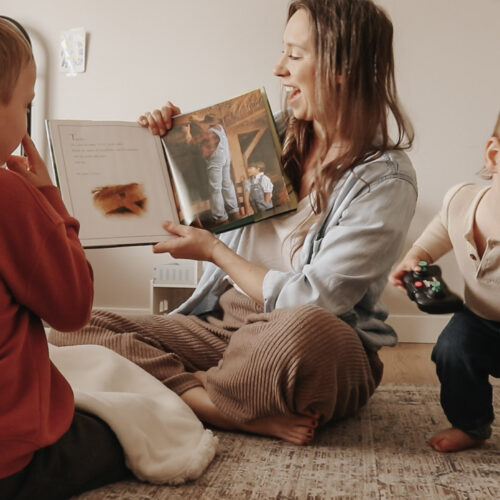
So try something small—when you feel tension rising in your home, pause and do something delightfully unproductive. Something spontaneous and silly. Something that spices up your routine. Make a fort in the living room for bedtime, story time, whatever your little heart desires.
But what about when your ordinary life doesn’t feel whimsical at all—when it feels like absolute chaos?
Embracing the Chaos
When I had my third child, my cousin gave me a coffee mug that said “embrace the mess.” She knew this type-A mama would struggle in the season of three under four. And as silly as it sounds, that mug truly helped me remember to embrace the chaos.
So how do you embrace the chaos? Do you just decide one day that you will? Well, sort of. But it’s more than that. You have to intentionally delight in it and remember that the enemy of joy isn’t chaos—it’s our obsession with controlling that chaos.
Delighting in the chaos is a matter of going from thinking that children pulling at your legs and a baby on your hip while cooking dinner is a burden—to being fully convinced there’s nothing better than that in the whole world. Knowing in your heart this is truly a gift.
Sometimes, the most profound joy comes when we let go of control.
When we stop expecting perfection, stop trying to make everything peaceful before we can be peaceful.
When we embrace the noise, the mess, the imperfection of life with little ones.
This season with little ones— is hectic, a little messy, a little unpredictable—but its short. We’re parenting little blessings, not raising perfectly obedient robots. Trying to force perfection only steals your joy, leaves you exhausted, and makes even the sweetest moments feel like burdens.
Smile First, Feel Joy After

So find excuses to smile. Even when you don’t feel like it. We often wait until we feel joyful before we express joy—but what if the order is reversed? What if we acted whimsical and then magically, discovered that joy just kind of appeared. Like a little experiment.
Science shows that the simple act of smiling—whether it’s real or forced doesn’t actually matter—signals to your brain that you’re safe. It lowers stress hormones and releases feel-good neurotransmitters like dopamine and serotonin. In other words, your face can change your heart. Proverbs 17:22 says, “A joyful heart is good medicine, but a crushed spirit dries up the bones.” When you smile, you’re literally participating in God’s design for renewal. You’re reminding your body and mind of His goodness.
Make it a goal this week to find excuses to smile—maybe commit to smiling at your children and your husband when they walk into a room, smile when you drop something and are annoyed, smile when things are falling apart. Over time, your emotions will start to change.
Joy isn’t a reward for when everything is how you think it ought to be—it’s the very thing that helps heal what you think is broken.
And if you’re thinking, ok Kyrie, this all sounds sweet, but I’m literally drowning in overwhelm. I’m overstimulated, burnt out, and every task feels monumental, I want you to know that I lived in that exact same place too – if you haven’t heard my story by now, keep watching my channel and you’ll learn all about how I was so burnt out through motherhood that it actually made me physically ill and had something called nervous system dysfunction and I was able to heal from that.
But it wasn’t one big change or even just a few home management habits. It was a full system. I had to completely change the landscape of my brain. That’s exactly what I walk through inside my free workshop, From Survival Mode to Peace-Filled Homemaking in 7 Days.
A Testimony of Joy Returning
I want to pause and share something powerful—a testimony from a woman who joined my course. She said:
“My husband had expressed struggling just wanting ‘his wife back,’ the vibrant woman I used to be. I have in the past time become overrun with stress, an emotional rollercoaster, struggling to find the root of my problems, waking up dreading the day, feeling like a failure, never enough, like a hamster running on a wheel with always more to get done, and like every right step led to another issue I couldn’t solve. When my husband and I started listening to Kyrie on YouTube, it struck deep and felt like God was calling us to this. I SO appreciate her approach and how the process helps draw you into a Deeper Relationship with Jesus…I have already seen so many little wins and have FINALLY started to feel Joy and love for my role as a wife and mother again. I am crying just thinking about this, because I wasn’t sure if I could. God is so good. I had come to my rope’s end and was feeling hopeless like there was no way out and that ‘my deepest struggle’ would be the memory that my children would keep as their childhood. That cut deep. But now, I know there is hope and God really TRULY can heal.”
That story moves me every time because it captures exactly what this journey is about—coming back to life again. When the fog begins to lift, it’s not because your circumstances changed overnight, but because your heart learned to see beauty in the same life that once felt unbearable.
“Motherhood doesn’t become heavy because we’re doing too much—it becomes heavy when the ordinary stops feeling meaningful.”
Practical Ways to Practice Intentional Celebration

So here are some practical ways to embrace this ritual of intentional celebration:
Start little daily traditions—Milkshake Mondays, Taco Tuesdays, Movie Night Saturdays.
Celebrate Sabbath rest by making one day of the week feel set apart—resting and enjoying one another as a family.
Create themed meal days—Pizza Fridays, Soupy Sundays.
Invent holidays and celebrate tiny milestones—half-birthdays, first days of school, your husband’s accomplishment at work. Always find a reason to celebrate.
Ecclesiastes 3:13 says, “Everyone should eat and drink and take pleasure in all his toil—this is God’s gift to man.”
Joy isn’t waiting for you in another season or after a milestone—it’s here, in today’s work the Lord has set before you.
Be spontaneous and inconvenience yourself.
Start a dance party in the kitchen while you’re cooking dinner—even if it means dinner’s fifteen minutes late. It will be inconvenient, but that’s where memories are made and joy is cultivated.
Or try what I call a “chaotic joy ritual.”
Get ahead of the chaos by being the creator of it.
Let your children help cook dinner—even if it means flour on the counters and spills on the floor.
Or take a walk and let them splash in every puddle they find.
These experiences are messy and unpredictable—but they build laughter, connection, and joy in the ordinary.
Smile more – be intentional about it. Give yourself smile anchors – when someone walks in a room, when you hear a certain word, whatever you decide, just let that be the thing that reminds you to smile.
This is how you make motherhood more joyful and whimsical: by seeing chaos not as something to fix, but as something to celebrate.
Strength for Contentment in Every Circumstance
Philippians 4:13 says, “I can do all things through Christ who strengthens me.” We see this on mugs and t-shirts, often used as a slogan for ambition or supernatural achievements—but that’s not what Paul meant. If you read the verses just before, Paul is talking about being content whether he has plenty or nothing at all. The strength Christ gives isn’t about climbing higher—it’s the supernatural ability to remain joyful in every circumstance. That’s the secret. You don’t need a new life to live differently—you need new eyes to see the same life through Christ’s strength.
Over time, you’ll notice a change in yourself, your children, and the atmosphere of your home: more laughter and more delight in the ordinary moments of life.
A Peaceful Home Begins Here
A peaceful home begins with a mother who’s willing to set aside control in order to delight in life again.
And if you feel stuck in survival mode, it’s not too late. You can feel calm, present, and full of laughter again. I’d love for you to join my free workshop using the link below.

Kyrie Luke



Leave a Reply