Mornings That Bend Without Breaking: Building a Sacred Rhythm in Motherhood
The best part about mornings, I’ve discovered, is that you get to establish your own blessed routine — a small sovereignty over the hours before the world makes its demands.
But here’s what no one tells you: some mornings will be gloriously derailed by a two-year-old who’s decided that 5:17am is the perfect time to discuss dinosaurs, or a baby who simply refuses the notion of sleep past dawn. And when that happens — when your carefully crafted morning dissolves before you’ve even lit your candle or opened your Bible — the temptation is to feel robbed, frustrated, as though the day has already failed you.
But what if we chose to see it differently?
What if, instead of mourning the routine we didn’t get, we remembered that being needed by small people in the early morning hours is not an interruption to our purpose — it is our purpose? There is nothing better in the world than this. Nothing more sacred than being the first face they seek, the first voice they hear. You were designed for this exact moment, this exact child, this exact season of early risings and unpredictable mornings.
The routine is lovely. The routine serves us well. But the routine is not our master — it’s our servant. And on the mornings when it must bow to a higher calling (the calling of a child who needs you), you haven’t lost anything. You’ve simply been reminded what all of this is for.
A Confession From a Lifelong Morning Person

Listen — I’ve always been a morning person.
I’ve always loved mornings. I’ve always woken up earlier than most – sometimes out of necessity but mostly out of desire.
And in most seasons of life, I’ve developed a lovely morning routine that makes me feel genuinely excited for the day ahead.
Except for one season – when I became a new mother.
I was lost. I didn’t know what to do with myself, I never knew how much time I would have on any given morning, and I felt completely frozen. So if that’s where you are today, I want to encourage you that this paralysis is temporary — and more importantly, it’s not a sign that you’re doing something wrong.
You’re in the thick of the most disorienting season of life, where sleep is fractured and time feels like it belongs to everyone but you. But you will find your footing again. Not by forcing yourself into someone else’s perfect routine, but by learning to build something flexible enough to bend with your real life.
Perhaps mornings don’t fall apart because of the children, but rather, because we stop being intentional once the stakes are higher and the variables multiply — when we can’t predict if we’ll have fifteen minutes or two hours, when a toddler’s mood or a baby’s wake window can completely reshape our plans, when the very people we’re trying to serve well are the same ones who make consistency feel impossible.
Today I want to walk you through everything I do before 7am, what I very intentionally do not do during my morning routine, and how you can build a morning rhythm that actually serves your real life — not an idealized one.
Do keep in mind that what I’m sharing with you is for stable seasons. When I’m postpartum, first trimester, sick, traveling, in the middle of a move, caring for an ill family member, or life is otherwise in survival mode — we enter what I call the Baseline Protocol and I’m not doing this morning routine. But this is the routine I go back to again when life levels out.
Why Mornings Matter More Than You Think
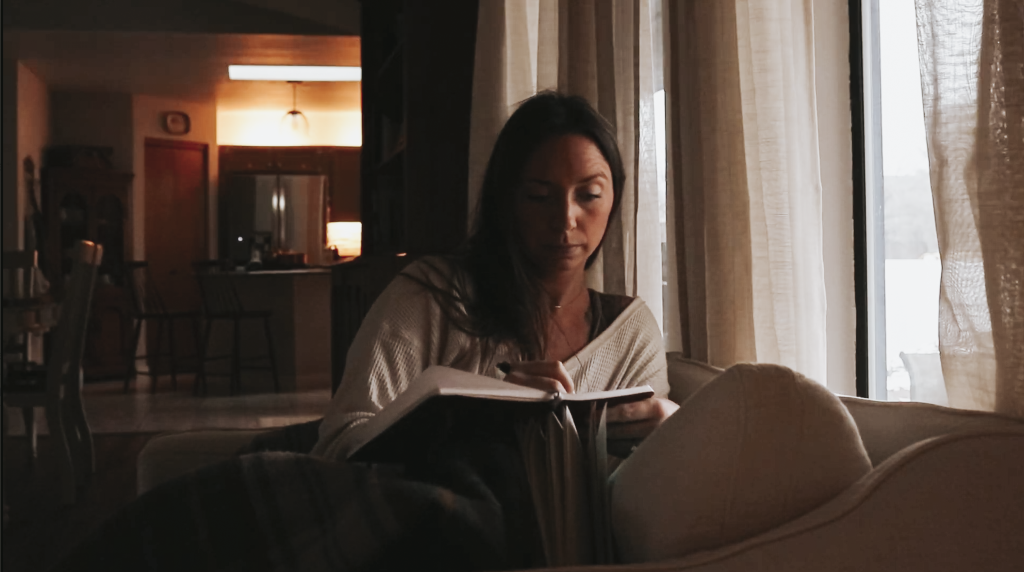
Most mothers aren’t overwhelmed because they’re doing too much.
They’re overwhelmed because they’ve gotten too used to pouring from an empty vessel — and then wonder why they’re running on fumes by 9am.
Here’s what I’ve come to understand: Your nervous system is taking notes in that first hour you’re awake. It’s learning whether today will be a day of groundedness or chaos, of intention or reaction. And whatever lesson it absorbs in those early moments — that sense of peace or that feeling of being perpetually behind — it will faithfully reproduce for the next sixteen hours.
Here’s what I’ve come to understand: your nervous system is taking notes in that first hour you’re awake. It’s learning whether today will be a day of groundedness or chaos, of intention or reaction. And whatever lesson it absorbs in those early moments — that sense of peace or that feeling of being perpetually behind — it will faithfully reproduce for the next sixteen hours.
The Foundational Principle Behind Every Morning Routine

Before I tell you what I do, you need to understand why mornings work at all.
Mornings are not for productivity.
They are for orientation.
And by that I mean it quite literally: the morning is when you orient your heart toward God before the world orients your heart toward itself. It’s when you remember—before the demands begin their clamoring—whose you are, what your purpose is, and what the Lord has for you in the day ahead.
There’s a reason the Scriptures speak so tenderly of the morning hours. “The steadfast love of the Lord never ceases; his mercies never come to an end; they are new every morning” (Lamentations 3:22-23). Every morning is a small resurrection, a new beginning, a reminder that yesterday’s failures need not define today.
But if we sleep through that reminder—or worse, if we wake and immediately drown it out with notifications and noise—we miss the gift the morning was meant to give us in the first place.
The world will set its agenda on you soon enough. Your phone will buzz. Your children will need you. The laundry will wait for no one. But in those early hours, before the sun has fully risen and before the household stirs, there exists a sacred space where you can set your mind on things above (Colossians 3:2).
Personally, I wake much earlier than I actually need to. I could, in theory, accomplish my morning tasks in half the time if I rushed through them with ruthless efficiency. But instead, I very much enjoy the stillness of those early hours, the luxury of slowly waking up and fussing over a few things before the real work begins.
There’s something comforting about not racing around like a wild woman trying to “get it all done,” but instead feeling like I have all the time in the world to accomplish whatever I like that morning.
So when I tell you what I do before 7am, understand that I’m not handing you a checklist for productivity. I’m showing you how I orient myself toward the day God has given me, so that when the chaos inevitably comes (and it will), I’m not meeting it from a place of depletion, but from a place of groundedness.
What I Do Before 7am
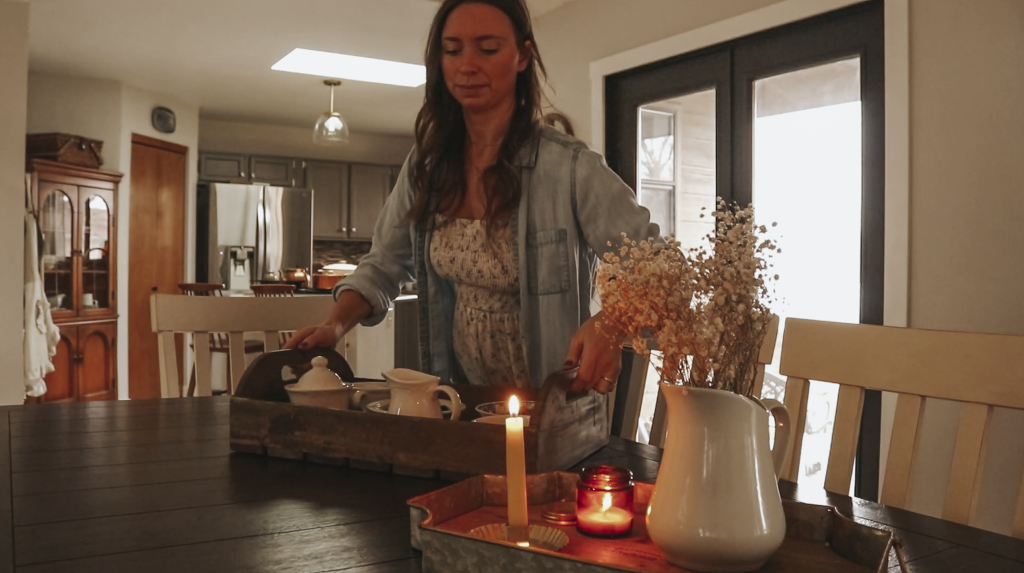
Now, I’m about to give you a list. And lists, I’ve found, have this unfortunate tendency to make us feel either wildly inspired or quite inadequate—sometimes both at once.
So before I say what follows, let me say this: I’m not suggesting you do all of these things, or even most of them. I’m simply showing you what works for me in this particular season, with these particular children, in this particular home of ours.
Your morning will look different. It should look different.
The goal isn’t to copy my routine; it’s to understand the principles behind it so you can build something that actually serves your life, not someone else’s.
1. I Drink 32oz of Water
As the day gets going and I get busy, it’s so easy to forget to drink water, so first thing, I drink 32 oz of water which is one full mason jar which we use as our water glasses.
Now if the day gets going and I don’t have a chance to drink water for a long stretch of time, I don’t feel like I have to play catch up.
2. Morning Walk
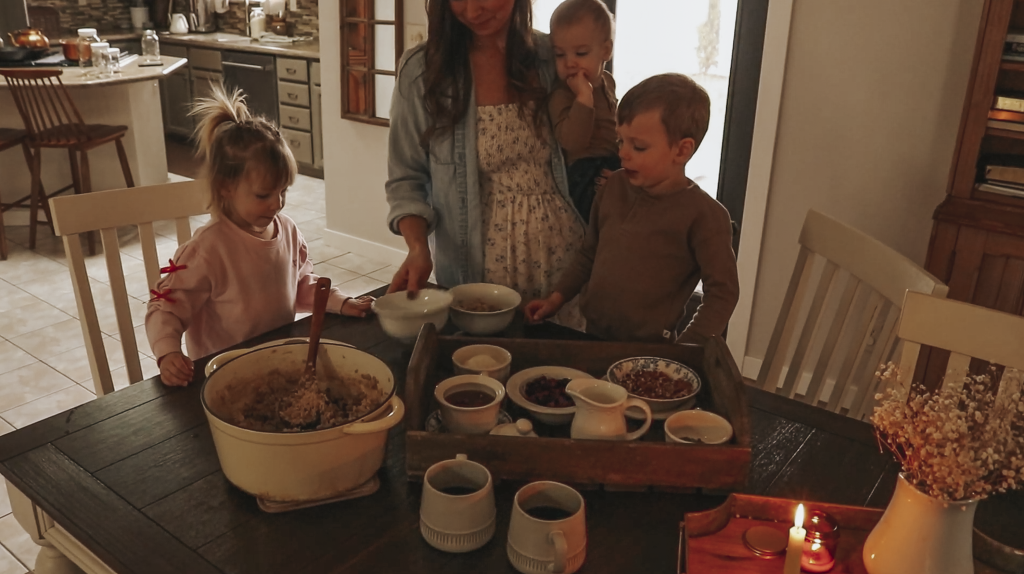
One of my favorite parts of my morning is when I can break out into the weather – whatever that weather may be. The other day I walked in 19 degree weather and it was glorious.
I think the key to waking up early is to move your body somehow – and also the fresh air is helpful.
When I walk I don’t have my phone on me, it’s usually dark depending on the season, and since its so early, there’s usually minimal noise. I use this time to think, pray and just ponder life.
This is often the time where I process things that need doing that day, I work through decisions I’m wrestling with, turn over questions that need pondering. And I just spend time with the Lord.
But perhaps my favorite part about my beloved morning walks is watching the seasons change. I get to see what about my surroundings looks different as the seasons change, and how the sights, sounds and smells transform.
There’s something truly magical about these morning walks and I’ve gone in and out of this routine over the years, but I never regret it when I do them.
The walks are wonderful, but my true love in the mornings is when I get to spend time in the Word.
3. Bible Time
I spent far too much time approaching my Bible as though it were a task to check off my list, a spiritual box to tick before I could consider myself a proper Christian. What exhausting nonsense that was.
Now—I come to these pages with something closer to desperation. An insatiable need, if you will. The kind of need that makes you realize you’ve been holding your breath and suddenly remember how to inhale again.
There is something about the morning hour that makes Scripture land differently, you know? Perhaps it’s that my mind hasn’t yet been colonized by the day’s demands.
I’ve discovered that starting the day in the Word is not about becoming a better mother, though that may be a happy consequence. It’s about remembering I am a daughter first.
That before I am needed, I am known. That before I pour out, I must be filled.
The truth is, Christian motherhood will drain you if you let it draw only from your own reserves.
But when you’ve sat with the Word first—when you’ve let it speak life into you, when you’ve let it reframe your perspective, and remind you of the eternal in the midst of the mundane—then you have something real to give.
Not your own strength, which is obviously insufficient, but His strength, which is more than enough.
4. Becoming Journaling
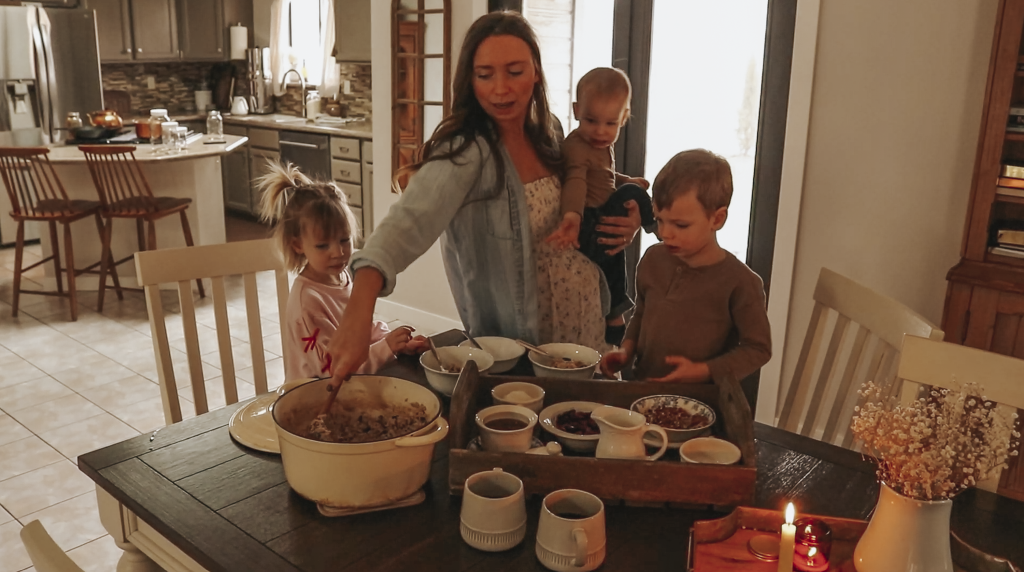
Next, I journal. Most of what you’ve been taught about journaling is probably keeping you stuck.
You’ve been told to process your feelings. To get it all out. To explore why you feel the way you feel.
And perhaps there’s a time and place for that sort of excavation—but not in my morning journaling.
I am not journaling to vent, spiral, or dissect my emotions.
I’m journaling to train my responses before emotion rises.
This is what I call Becoming Journaling, and it operates on an entirely different premise than the journaling you’ve likely tried before.
Traditional journaling asks: How do I feel?
Becoming Journaling asks: Who am I becoming?
Becoming Journaling is the practice of writing future-tense identity statements—not as affirmations you’re trying to convince yourself of, but as a way to retrain your brain on who you are and how you respond to your family.
You’re not manifesting. You’re not pretending.
You’re aligning your mind with the truth of who God is sanctifying you into, before the day has a chance to tell you otherwise.
These aren’t wishes. They’re not goals.
They’re rehearsals.
You are training your thought patterns and your default responses—before you need them.
And then—and this is crucial—I don’t just write them and move on.
I sit with them.
I let them settle.
I imagine what it will look like when that version of me shows up today.
I picture the moment: the spilled milk, the whining, the interruption, the disappointment.
And I see myself responding as the woman I’m becoming, not the woman I was yesterday.
This is the renewing of your mind that Paul talks about in Romans 12:2.
It’s taking every thought captive.
It’s training yourself in godliness.
It’s doing the internal work before the external pressure arrives.
Because motherhood doesn’t wait for you to be ready.
The toddler meltdown doesn’t pause while you collect yourself.
The sibling argument doesn’t give you time to process your triggers.
The sleepless night doesn’t care that you’re already running on empty.
Motherhood is relentless, and if you’re only ever reacting—if you’re only ever responding from your current emotional state—you will be perpetually behind.
But when you’ve spent your morning rehearsing patience, rehearsing calm, rehearsing trust and when you’ve already written the story of who you’re becoming then when the moment comes—you have something to draw from.
You’ve already been there in your mind.
You’ve already practiced the response.
And while you won’t be perfect (you’re still human, still sanctified but not yet glorified), you’ll find that you have a split second more of space.
A breath more of clarity.
One degree more of patience.
And in motherhood, that split second is everything.
5. Workout
Next, I workout. Usually some sort of weight lifting routine in this season and usually just about 30-40 minutes, sometimes less if the morning is pressing in early.
For me, this is about having the physical margin to meet the demands of the day without my body giving out before my children’s needs do.
It’s about being able to hike with them, play with them, work alongside them in the garden or the kitchen without feeling like I’m running on fumes.
I’m not training for a competition.
I’m training for a life.
For the decades of motherhood ahead.
For the strength to serve well and have the energy to keep up with my little ones.
6. Planning the Day
Next, I plan for the day ahead.
This is very easy for me in the morning because I do all my planning the night before.
So really, in the morning I just glance at my planner to see what lies ahead and to orient myself for the day.
What I Very Intentionally Do Not Do
I Don’t Check My Phone
When you reach for your phone before you’ve even fully woken up, before you’ve had a single thought that’s entirely your own, you’re handing the reins of your day to someone else.
To everyone else, actually.
To the algorithm.
To the news cycle.
To whoever texted you last night.
To the carefully curated highlight reel of someone else’s life.
The outrage.
The endless scroll of things that want your attention.
I know this because I’ve done it.
I’ve woken up, reached for my phone “just to check the time” (we all know that trap), and found myself twenty minutes deep in emails, texts, Instagram stories, news headlines—none of which I needed to see, and all of which left me feeling anxious and behind before my feet even hit the floor.
So I don’t check my phone in the morning.
Not until after my routine is done.
One caveat is that I DO use my phone as a tool SOMETIMES when I’m having a hard time keeping my eyes open and the blue light snaps me out of that a bit, but its rare that I need that after my morning walk.
I Don’t Drink Coffee First Thing
I know. I know.
This one feels like heresy, especially coming from someone who genuinely loves coffee.
Who considers a well-made cup one of life’s small, delightful pleasures.
But here’s the thing: I don’t drink it first thing in the morning.
And before you protest, let me explain why.
When I was experiencing nervous system dysfunction years ago, I noticed that when I drink coffee my symptoms really increased so naturally I thought the issue was coffee.
Once I cut it out those specific symptoms resolved slightly, but not long term and not completely.
Then I realized that if I just pushed coffee out a couple hours after waking, those symptoms didn’t flare up and I could still enjoy coffee.
Your body wakes up with a natural surge of cortisol.
It’s your built-in alarm system, designed to get you alert and ready for the day.
This cortisol peak happens in the first 60-90 minutes after you wake up, and it’s doing exactly what you’d want coffee to do: making you feel awake, focused, energized.
When you drink coffee during your natural cortisol peak, you’re introducing a stimulant when your body is already stimulating itself.
Over time, this can do two things: it can blunt your body’s natural cortisol response, and it can increase your tolerance to caffeine.
The result is that you end up needing coffee just to feel normal, rather than using it strategically to feel energized—or simply because you enjoy the taste of a well-made cup of black coffee.
I Don’t Eat Immediately
This one might sound strange, especially in a culture that’s told us breakfast is the most important meal of the day.
But here’s what I’ve learned: my body doesn’t actually need food the moment I open my eyes.
And more importantly, eating immediately—out of habit rather than hunger—can interrupt something quite valuable that’s already happening.
When you sleep, your body enters a fasted state.
During this time, your body gets to do important housekeeping: cellular repair, hormone regulation, mental clarity.
When you wake up, that fasted state is still active.
There’s a mental sharpness, a lightness, a sense of not being weighed down before the day has even begun.
This isn’t about skipping breakfast.
I eat breakfast.
I love breakfast.
But I eat it when I’m hungry, not when I’m supposed to be hungry.
Keep in mind I’m not recommending anything, just letting you know what I do and what works for me.
A Little Context About Our Life Right Now
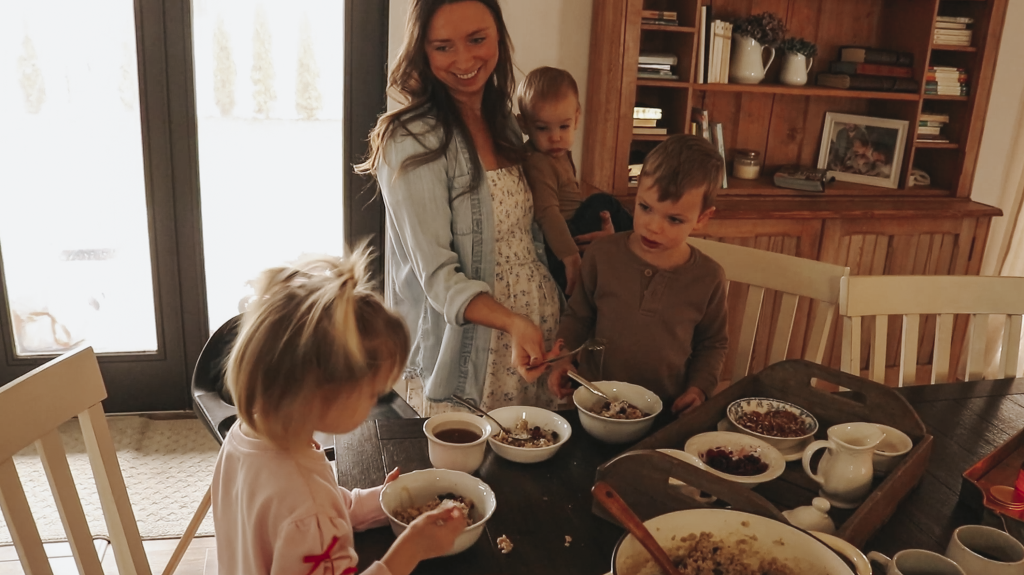
Now, I know what you’re thinking—because I would be thinking it too: what does your actual life look like?
So let me pull back the curtain to give you some context into my life as it is right now in this season.
- What time kids go to bed: anywhere between 7–8pm
- What time kids wake up: usually 7am
- What time I go to bed: usually 9:30pm, sometimes 8:30pm
- What time I wake up: sometime within the 4am hour
- When my husband sleeps and wakes: he goes to bed around the same time and wakes around 6am
How to Build Your Own Morning Rhythm
Now let me help you build your own morning rhythm.
First, you need to build a rhythm for your whole day in order to know what needs to be done in the morning.
Step 1: Brain Dump What Feeds Your Soul
Grab a piece of paper and write down everything—and I mean everything—that makes you feel like yourself.
What feeds your soul?
What makes you feel alive, grounded, creative?
Step 2: List What You Think Can’t Be Done With Children

Now, look at that list and circle everything you believe requires child-free time.
Be honest.
Step 3: Challenge That Assumption
So many mothers are wasting their precious quiet morning hours doing things they think can’t be done with children around—when actually, with a little creativity and structure, they absolutely can.
When you do these soul-giving activities with your children around—even imperfectly—you’re teaching them something profound.
You’re showing them that mothers are whole people.
Step 4: Identify True Child-Free Windows

Make a list of every child-free window you have in a given week.
Suddenly you may realize you have more time than you thought.
The question is: how will you use it?
Step 5: Assign Tasks Intentionally
Take your list of things that truly need child-free time, and plug them into those windows.
Reserve your mornings for what feeds your soul.
Step 6: Choose a Consistent Wake Time
Pick a specific time and stick to it—every day.
Your body craves consistency.
Step 7: If the Wake Time Feels Ridiculous

Prioritize ruthlessly.
Rotate tasks.
Shorten everything.
The goal is not the most impressive routine.
The goal is a morning that serves you.
The Heart of It All
The morning isn’t a productivity contest.
It’s not about how many things you can check off before your children wake up.
It’s about creating space for the woman you’re becoming to actually show up in the life you’re living.
You can’t serve your family with wisdom if you haven’t given yourself time to remember what wisdom sounds like.
And if you’re reading this thinking, I want this—but I don’t know how to move from survival into this kind of grounded, peaceful motherhood, you don’t have to figure it out on your own. I walk through the exact process I followed to go from exhausted and overwhelmed to building a peaceful, joyful home—even when my circumstances didn’t change—in my free workshop linked below. It’s a step-by-step framework designed for real mothers with real lives, not idealized routines.
If you’re longing to become the patient, peaceful woman you know God is calling you to be, I’d love to invite you to start there.