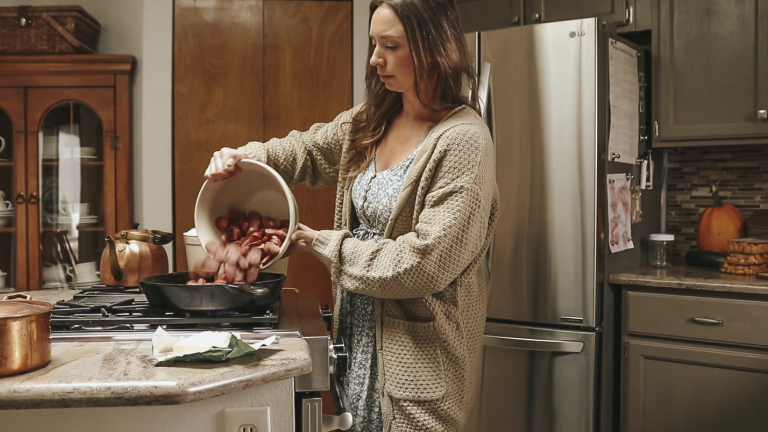
What My Parents Got Right — And How It Shaped the Woman I’m Becoming
We live in a generation obsessed with what our parents “did wrong.”
It’s almost trendy now—use their mistakes as explanations for our dysfunction.
But what if we chose the harder, Biblical thing?
To speak honorably about our parents regardless of their shortcomings.
To say: there was, of course, something they did right… and I’m going to hold onto that and honor them for that.
Maybe imperfectly.
Maybe with no money, no support, no internet to guide them.
Yet somehow, their efforts helped form us into women who love our families, love the Lord, and long to create peaceful, joy-filled homes.
So today, instead of asking “What went wrong?”
I want to ask you:
What did they get right? And how did it shape you into who you are becoming?

Choosing Gratitude Over Grievance
There are a thousand things I could complain about from my childhood if I wanted to. We didn’t have a lot of money. I didn’t get an allowance. My first car wasn’t handed to me with a bow on top.
And yet when I look back, I can see so clearly:
my parents were actually brilliant—and that changed everything about who I became.
Before I get into all the brilliant things my parents did, there’s something important you need to know for context.
My parents didn’t get an “easy” situation with me—with my history and all the layers that came with it. I was adopted from a drug-addicted mother, and by the time they got me, I already carried a lot of baggage for a child my age. Trauma, fear, old patterns, survival instincts.
And before I was officially adopted, they were limited in what they could do because I was a foster child. There were rules, restrictions, things they couldn’t enforce yet even when they knew I desperately needed structure and safety.
So when I say my parents were brilliant, I don’t mean they did everything perfectly.
I mean they stepped into a messy, complicated story with both feet. And somehow, in the middle of all that, in a world without the endless parenting resources and technology we have today, they still managed to get so many things right.
Alright. Let’s talk about what my parents did right—and why it matters for you and me now. I’ll go into the habits and disciplines that shaped me, the boundaries and responsibilities that formed my adulthood, and at the very end I’m telling you the single BEST thing my parents did that set the foundation for a strong, joyful, Christ-centered marriage of my own.
Faith as an Invitation, Not a Force

I think so many parents treat their children’s faith as a badge of honor—“Look, my child is a believer, I did everything right”—and the opposite is true too: the parents whose children walk away feel shame. But Scripture is clear that the work of salvation is God’s, not ours.
“For it is God who works in you, both to will and to work for His good pleasure.” (Philippians 2:13)
We steward, we model, and most of all, we pray—but God is the one who transforms hearts.
I was raised non-denominational Christian. We went to church sort of off and on. I have memories of my mom and I reading the Bible together, taking turns between each paragraph, and we prayed… but my parents never suffocated us with religion.
There wasn’t this constant pressure of,
“You must feel this exact way about God right now.”
Faith was just there as a sort of invitation. I think my parents would have liked to make it a more prominent influence in our lives, and I think if they could do it all over again now, they definitely would. But I think the foundation they provided was exactly what led me back to Christ after falling away.
Why This Mattered
That approach built a faith in me that was curious rather than terrified, and personal rather than performative. It taught me to come to God because I wanted to, not because I was scared of being punished, and it built a foundation for my adult relationship with Jesus.
And now as a mother, although I do things differently than my parents, it was my parents’ foundation that gave me the confidence to raise my children in a home where faith feels alive, relational, and rooted in love rather than pressure.
Discipline, Honesty, and Consequences
Nothing shaped my character more than my parents’ commitment to honesty.
Lying was the biggest offense in our house. My parents made it very clear:
you can make mistakes, but you cannot lie about them. If you lie, the consequences were immediate and significant—because lying was seen as a break in trust, not just a bad choice.
Now as a parent, I can absolutely see why. Truth is the ground everything else stands on. Without honesty, there’s no real relationship, no real safety.
Scripture even tells us that lying breaks fellowship with the Lord:
“No one who practices deceit shall dwell in my house.” (Psalm 101:7, ESV)
And practically? A life built on lies collapses. A child who is allowed to lie becomes an adult who sabotages their own future and someone who doesn’t value truth—which, in turn, can leave them unable to recognize truth at all.
Scripture warns that when we suppress the truth, our thinking becomes futile and our hearts become darkened.
The longer we tolerate “small lies,” the foggier biblical truth becomes, until even the obvious things feel unclear.
Another form of discipline growing up was writing “sentences.”
If the rule was “no running in the house,” and I ran down the hall, they’d write something like:
“I will never run down the hall again.”
And I would have to copy that over and over and over. Sometimes it wasn’t just a sentence—sometimes it was a whole paragraph. And we’d have to write it a hundred times or however many times my parents decided would be a good number.
You know what happens when you write something out 100 times?
It gets into your brain. Brilliant.
Their yes was yes and their no was no. I don’t think I can ever think of a time when my parents said there would be a consequence for some sort of disobedience and it didn’t happen.
They lived by Matthew 5:37:
“Let what you say be simply ‘Yes’ or ‘No’; anything more than this comes from evil.”
This was brilliant because if truth was so important to them and they made liars out of themselves by saying they were going to do something and then didn’t do it, we would see them as hypocrites.
Their consistency taught me that authority is trustworthy, not unpredictable—and that integrity matters as much in parenting as it does anywhere else.
They were told a lot that they were “too harsh.”
But those same people would turn around and say,
“Your girls are so well-behaved,” referring to my sister and me.
Their firmness produced fruit—fruit that outsiders admired, even if they didn’t understand the method.
Work Ethic and Life Skills

We didn’t grow up with a lot of money, but I grew up rich in examples of what consistent hard work looks like.
We didn’t get an allowance, and I remember hating this as a child—feeling so left out of all the kids who got paid for doing basic chores. Now, as an adult, I see how entitled that mindset was. Why should I get paid for being part of the family?
Everyday contributions to the household—cleaning our room, doing the dishes, basic housework—were simply part of being in the family. We were contributing members of the household, and that was just expected.
My parents taught us how to do an exceptional job at cleaning the house. We didn’t just do a quick clean. We moved furniture, vacuumed underneath, wiped baseboards, and scrubbed the sink after doing the dishes.
At the time, I thought my parents were just exceptionally clean people. But I remember one of my first jobs at a coffee shop—moving the garbage can to sweep behind it—and my boss was so impressed. I remember thinking how bizarre it was that people don’t do that.
My parents also taught me hard work by how hard they worked to support our family. I remember my dad’s side jobs, helping with his gutter-cleaning business, and going house to house delivering phone books.
And through this, I learned the reality that money often comes from unflashy but consistent hard work—not magic opportunities.
Simple Fun and Family Culture
We didn’t have much money growing up, but one thing we didn’t have was lazy parents. They worked hard, but they also played hard.
We went camping and hiking constantly. It felt like every nice weekend—and maybe even the rainy ones—we were either camping or hiking.
It wasn’t fancy. It wasn’t curated. It wasn’t extravagant vacations.
It was tents, bug spray, sore legs, and my mom’s famous breakfast cooked over an open campfire.
For a season, my parents would wake up early to do walking workout videos in the living room. No fancy gym. No boutique memberships. Just determination.
Hearing them stomping around at 5 a.m. taught me that fitness isn’t about aesthetics—it’s about discipline, stewardship, and using what you have.
Reading and Learning to Love Learning

My love for reading began in my childhood home.
There was a program at my school called “Read and Lead.” We had to log a certain number of reading hours every year, and I always hit my goal because my mom and I would sit and read for hours.
Reading was just what we did.
We’d take turns.
She would read.
Then I would read.
Then she would read.
Then I would read.
This built a genuine love for learning. It built the attention muscle I needed to navigate a world constantly trying to fragment our focus.
It laid the groundwork for journaling, Bible study, reflection, and the kind of deep thinking that now feels familiar to my brain.
This shift—slowing down, renewing the mind, rebuilding these muscles as an adult—completely changed how my home feels.
Technology, Phones, and Boundaries
I didn’t have a phone for a very long time. And when I finally did, it came with rules I absolutely hated.
If the phone became a problem, it lived on the counter. End of story.
My parents monitored what I was doing—and it wasn’t invasive. It was biblical.
“Train up a child in the way he should go.” (Proverbs 22:6)
Oversight isn’t a violation. It’s obedience.
At the time, I thought it was unfair. In hindsight?
One hundred percent wise.
It taught me that technology is a tool, not a right—and that parents are allowed to protect their children, even when it’s unpopular.
Money, Cars, and Responsibility
When we got a car, we paid for it. My parents covered insurance until we got a ticket or into a wreck—then it was on us.
Well, I got into a wreck due to speeding. Nothing teaches financial reality faster than watching an entire Taco Del Mar paycheck disappear into insurance and gas.
It was painful—and unforgettable.
I learned that even small mistakes have real costs.
Now, when I think about my own kids, I don’t want to hand them everything. I want them to feel that weight so they can learn to steward it well.
Mealtime and Family Rhythm

Dinner wasn’t a negotiation—it was the option.
My parents didn’t make separate meals. There was dinner, and we ate it. Some meals we loved, some weren’t our favorite, and that was life.
And yet, we almost always had dessert.
This built a healthy relationship with food—no drama, no power struggles, just shared meals.
The Gift of Their Marriage
The most brilliant thing my parents did was give my sister and me the gift of their marriage.
They unapologetically prioritized each other. They served one another, spoke well of each other, and genuinely enjoyed being together.
I never wondered if they loved each other—it was obvious.
They were junior high sweethearts, and their love didn’t just “happen.” It was built through daily, intentional choices.
Watching their marriage showed me that marriage isn’t something you survive—it’s something you cultivate.
And the greatest gift we can give our children is a strong marriage.
Choosing What to Carry Forward
I am not a perfect mom.
My parents weren’t perfect parents.
But they gave me a foundation I’m deeply grateful for—and now I get to choose how to build on it.
If you’re thinking,
“I didn’t have parents like that… but I want to be that kind of parent,”
I want you to know: it’s not too late.
You can break generational patterns.
You can become the peaceful, grounded mother your children feel safe with.
So let me ask you:
What did your parents do right?
What’s one thing you want to carry forward into your home?
If you’d like help becoming the woman and mother you’re longing to be, my free workshop is available to you—completely free—and I’d love to walk that journey with you.